
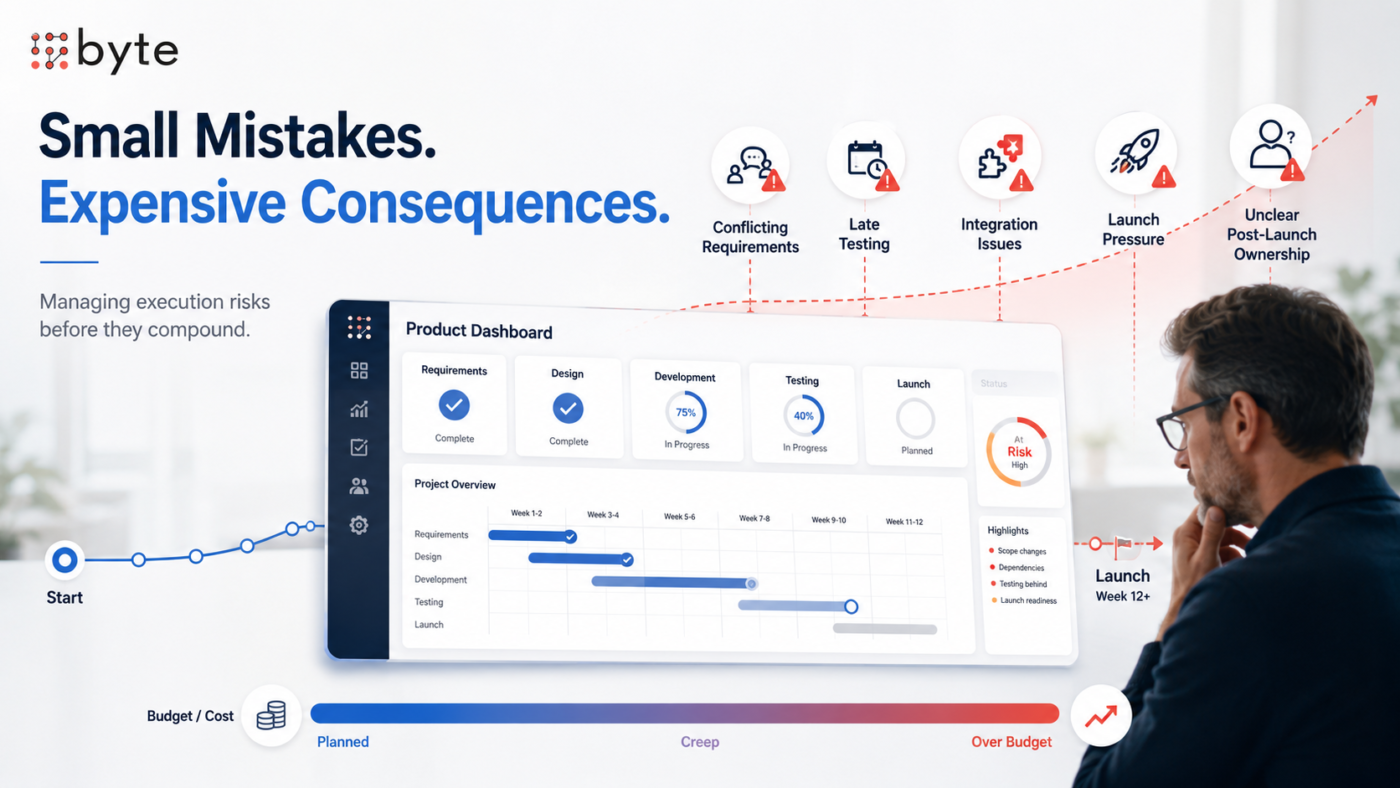
Software projects at startups rarely go over budget because of one major mistake. Costs usually build through smaller software development mistakes: decisions change without being recorded, testing is pushed back, integrations take longer than expected, and launch dates remain fixed even when the work has grown.
Any one of these issues may seem minor. When several happen at once, the project can quickly move beyond its original budget and timeline.
Founders do not need to supervise every technical detail. They do need enough visibility to notice when the project is starting to drift.
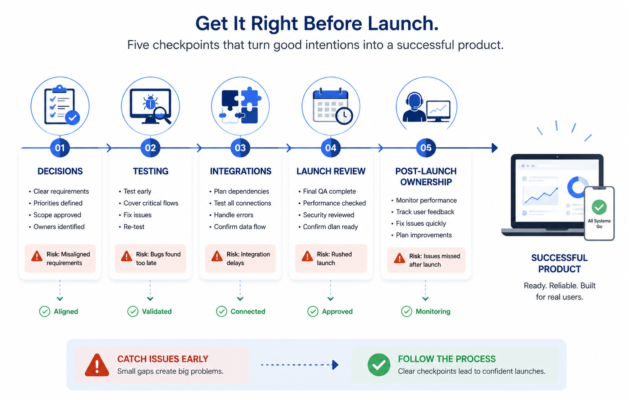
Here are five mistakes that can quietly make a software build more expensive than it needs to be.
1. Requirements and Decisions Are Not Properly Controlled
Changes are normal during development.
A founder sees the first prototype and wants to simplify a workflow. A customer asks for a missing feature. The operations team notices that the original process will not work in practice.
The trouble starts when requests arrive from several people and nobody has the final say.
A founder may approve a workflow on Monday. On Wednesday, the sales manager asks the developers to change it. By Friday, the operations lead has given the team a different set of instructions.
The team stays busy, but the product barely moves forward. They are rebuilding the same feature around conflicting feedback.
Important decisions can also disappear inside calls, emails, and chat messages. Someone says, “We will leave that for the next release,” but the decision is never recorded. Weeks later, the same feature returns as something the team supposedly forgot.
A short written record is often enough:
The two-step onboarding process was approved on July 14. Additional identity verification will be considered after the first release.
That note gives everyone a reference point. It also separates deferred work from missing work.
Before development moves too far, the team should agree on:
- Who has final approval authority
- Where requests and decisions will be recorded
- How changes will be reviewed
- Which items belong in the current release
- What happens to the timeline when new work is added
A clear software development Scope of Work establishes the initial boundaries. During delivery, those boundaries still need active management.
2. Testing Starts Too Late
Testing is often treated as the final stage of a build.
The product is nearly complete, the launch date is close, and the team begins checking whether everything works. By then, there may be little room left to fix what testing reveals.
Late testing can uncover issues such as:
- A workflow works on desktop but breaks on mobile
- One user role can access information meant for another
- Two features work separately but fail when used together
- Imported data appears in the wrong fields
- A payment succeeds, but the order status does not update
These are not always small corrections. A problem discovered near launch may affect the interface, database, permissions, integrations, and reporting at the same time.
Developer testing and user acceptance testing also answer different questions.
The development team checks whether the software behaves according to the agreed requirements. The client and intended users check whether the workflow makes sense in practice.
A feature can work exactly as designed and still be confusing to use.
Testing should happen throughout the project. Review important features when they are completed. Test integrations before the final sprint. Let real users try the most important workflows before the launch date creates pressure.
Catch the problem early and the team still has choices. Discover it in the final week and every fix becomes rushed.
3. Integrations Are Underestimated
An integration can look simple in a proposal:
- Connect the CRM
- Add online payments
- Sync the accounting system
- Send leads to an email platform
- Enable third-party login
The visible result may be one button or automated action. The work behind it can be much more involved.
The team may be dealing with incomplete documentation, limited account permissions, inconsistent data, vendor approval requirements, rate limits, or an older system that was never designed to connect with a new product.
Consider a startup that wants every new customer record sent into its CRM.
The connection itself may work, but the team still has to decide:
- Which fields should transfer?
- How should duplicate records be handled?
- Which system becomes the main source of truth?
- What happens when the CRM is unavailable?
The answers affect data mapping, error handling, testing, and future reporting.
Before an integration is added to the timeline, the development team should review the third-party system, confirm access, inspect the available API, and identify any licensing or approval requirements.
If the technical details are still unclear, say so in the estimate instead of treating the integration as routine work. Treating an untested integration as a routine add-on is one of the quickest ways to create unexpected work.
4. The Launch Date Is Set Before the Remaining Work Is Understood
Startups often choose launch dates around investor meetings, marketing campaigns, customer commitments, or industry events.
The date may matter, but it does not make the remaining work disappear.
A realistic launch plan must include more than coding. The remaining work may involve:
- User acceptance testing
- Bug fixes
- Data migration
- Team training
- Production setup
- Security checks
- Third-party approvals
- Launch monitoring
Problems arise when the scope expands but the deadline stays unchanged.
The team may respond by reducing testing, delaying documentation, or pushing unfinished decisions into the final week. The product reaches the announced date, but the business inherits problems immediately afterward.
Review the remaining work before promising that the original date still holds.
When the schedule no longer matches the scope, leadership has three realistic choices:
- Reduce the first-release scope
- Add appropriate resources
- Move the launch date
Trying to keep the same scope, budget, and deadline usually leads to a rushed release rather than a successful one.
5. Post-Launch Ownership Is Not Planned
Launch day receives plenty of attention. The weeks after launch often receive much less.
Once real users enter the product, they may behave differently from the test group. They may enter unexpected information, follow workflows in a different order, or reveal areas of confusion the internal team did not notice.
Someone needs to own what happens next.
The startup should know:
- Who monitors the live product
- Where users report problems
- Who decides which issues are urgent
- How bugs are prioritized
- How user feedback reaches the roadmap
- What support is covered by the original agreement
Not every post-launch request should become immediate development work.
Some issues will be genuine defects. Others may be training questions, individual preferences, or ideas for a future release. Without a process, every piece of feedback can feel urgent.
The startup should also understand the difference between warranty, support, maintenance, and new development. A bug in an agreed feature is different from a request for a new report, revised workflow, or additional integration.
These responsibilities should be settled before launch, not during the first production problem.
Keep the Project Visible
Founders cannot prevent every change, delay, or technical issue. Software development always involves some uncertainty.
What founders can do is keep the project visible enough to catch problems before they become expensive.
During the project, leadership should be able to answer:
- Who has the final say on product decisions?
- Where are approved changes recorded?
- What is being tested now?
- Which integrations still carry uncertainty?
- Does the launch date reflect the work remaining?
- Who takes responsibility after launch?
When those answers are clear, small issues are less likely to become expensive rework.
Successful startup software development depends on more than good code. It also requires controlled decisions, useful documentation, early testing, realistic timelines, and clear ownership after release.
Byte Advisory helps startups define the work, test early, manage changes, and prepare for launch without losing control of the project.
Preparing to build or improve a software product? Speak with Byte Advisory before small issues become costly.
[email protected]
byteadvisory.com/contact/