AAV Gene Therapy — Structural Biology Research
Peer-reviewed cryo-EM work on the only FDA-approved gene therapy vector
Real engagement, published with the client’s permission.
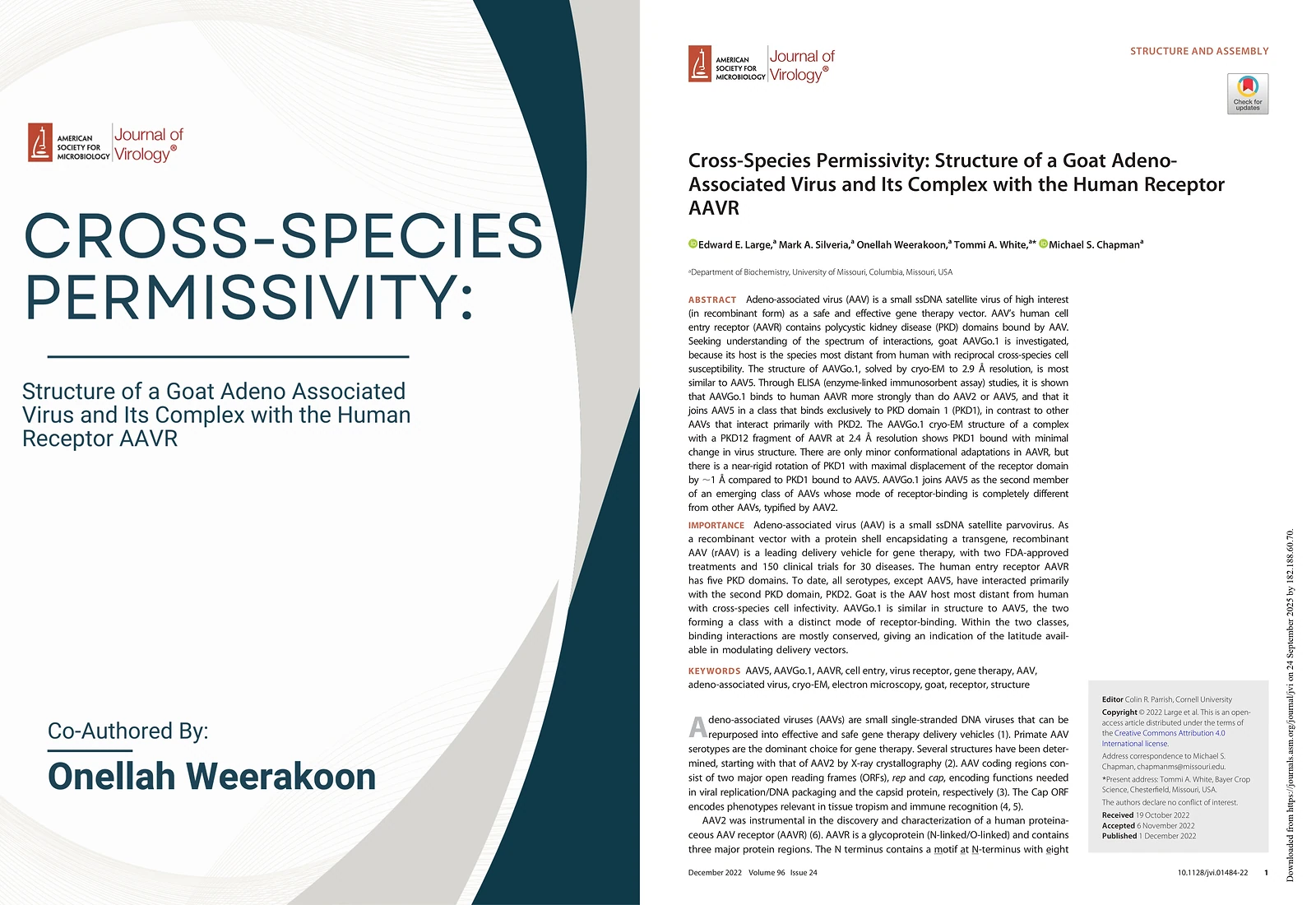
Fig. 01 — Journal of Virology, 2022.
- 2.9 Å Cryo-EM resolution achieved
- 3 Peer-reviewed publications
- +25% Protein purification yield gain
Overview
Structural biology research on adeno-associated virus and its human cell entry receptor, conducted in the Chapman Lab at the University of Missouri and published across three peer-reviewed outputs. AAV is the only gene therapy vector class approved by the FDA — the basis of Zolgensma, Luxturna and Hemgenix.
The problem
Designing efficient gene therapy vectors depends on understanding how AAV engages its receptor — and on knowing how far that engagement generalises across species, which determines which capsids are viable candidates.
What we did
- Applied cryo-EM to characterise AAV–AAVR interactions across serotypes.
- Used COOT and PyMOL to interpret electron density maps and refine macromolecular structures.
- Solved the structure of goat AAVGo.1 at 2.9 Å and its complex with the human AAVR receptor, establishing cross-species receptor permissivity.
- Optimised protein purification protocols, increasing target protein yield by 25%.
Delivered
- Peer-reviewed publication in Viruses (MDPI)
- Peer-reviewed publication in Journal of Virology (ASM)
- First-author conference research, ASV 2023 and WCSB 2023
- Refined macromolecular structures of AAV and AAVR
Outcome
Three peer-reviewed outputs, presented at national conferences in the United States and featured internationally in Belgium and Italy.
Specification
Practices: Biotech Consulting
Industries: Biotech & Medical Device, Healthcare
Links
AAV Gene Delivery — Viruses (MDPI), 2021 ↗
Cross-Species Permissivity — Journal of Virology, 2022 ↗
Inside the build

Fig. 02 — Viruses (MDPI), 2021.
Have something like this?
Book an intro call with Byte Advisory.
Peer-reviewed cryo-EM work on the only FDA-approved gene therapy vector