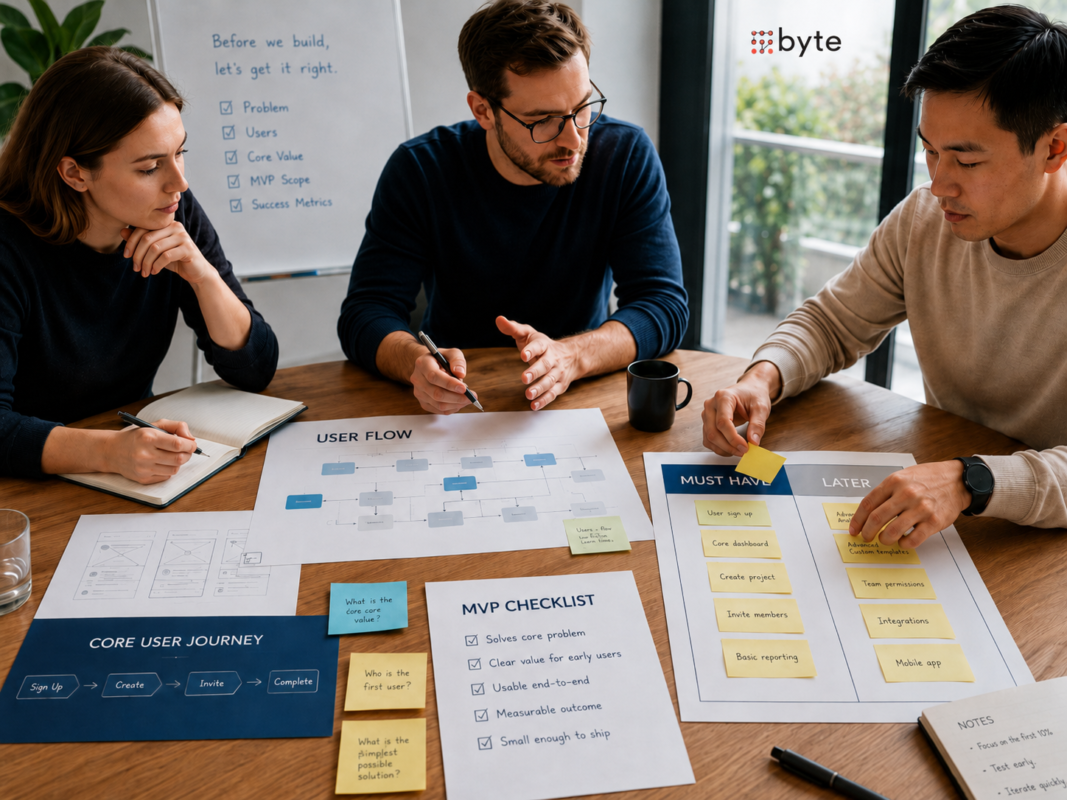
For founders, hiring a development team can feel like the moment an idea starts becoming real.
The concept is clear. The opportunity feels exciting. There may be early customer interest, investor conversations, or internal pressure to launch quickly.
But before development begins, one question matters:
Is the product clearly defined enough to build?
A development team can bring an idea to life, but it cannot replace product clarity. If the business problem, user journey, scope, budget, ownership, and success metrics are unclear, the project can quickly become slower, more expensive, and harder to manage.
Many founders do not struggle because the idea is weak. They struggle because development begins before the product is defined well enough.
The goal is not to create unnecessary documentation. The goal is to give the development team enough direction to build the right thing, in the right order, with fewer surprises.
Why Clarity Before Development Matters
Development work becomes harder when the scope is unclear.
A founder may say they need an app, platform, dashboard, portal, or MVP. But those words can mean very different things depending on the users, workflows, features, data, integrations, and long-term roadmap.
Without clear direction, the development team is forced to make assumptions. They may assume how users should move through the product, which features matter most, what the admin side needs, or how flexible the system should be later.
Those assumptions can create problems.
Features may be built before they are validated. Important workflows may be missed. The product may become too complex too early. Budget may be spent on parts of the system that do not matter yet.
Technology projects do not fail only because of bad code. Many fail because the business did not clearly define what needed to be built before coding began.
Define the Business Problem First
Before defining features, founders should define the business problem.
- What problem does the product solve?
- Who has that problem?
- Why does it matter?
- What should improve once the product exists?
This step helps turn a broad idea into a focused product.
A founder may want a customer portal, but the real problem may be that customers lack visibility into project status. A founder may want an internal dashboard, but the real problem may be that the team spends too much time collecting updates from different systems.
When the business problem is clear, the product becomes easier to define.
The development team can understand the purpose behind the build, not just the requested features. That makes it easier to recommend the right structure, avoid unnecessary complexity, and focus on the first version around the outcome that matters most.
Define the Core User and User Flow
After the business problem is clear, founders should define the core user.
A product may have customers, admins, vendors, employees, managers, or partners. Each user may need different access, features, and workflows.
Trying to build for every user at once can make the first version too broad.
Before development begins, founders should identify the most important user for version one.
- Who is the primary user?
- What do they need to accomplish?
- Where does the experience begin?
- Where does it end?
- What should be simple, fast, or automated?
This is where user flows become important.
A user flow maps the path someone takes through the product. It helps show what screens, actions, forms, data, notifications, and outputs are needed.
User flows help the development team understand how the product should actually work. They also help founders see whether the first version is focused enough.
Define the MVP Scope
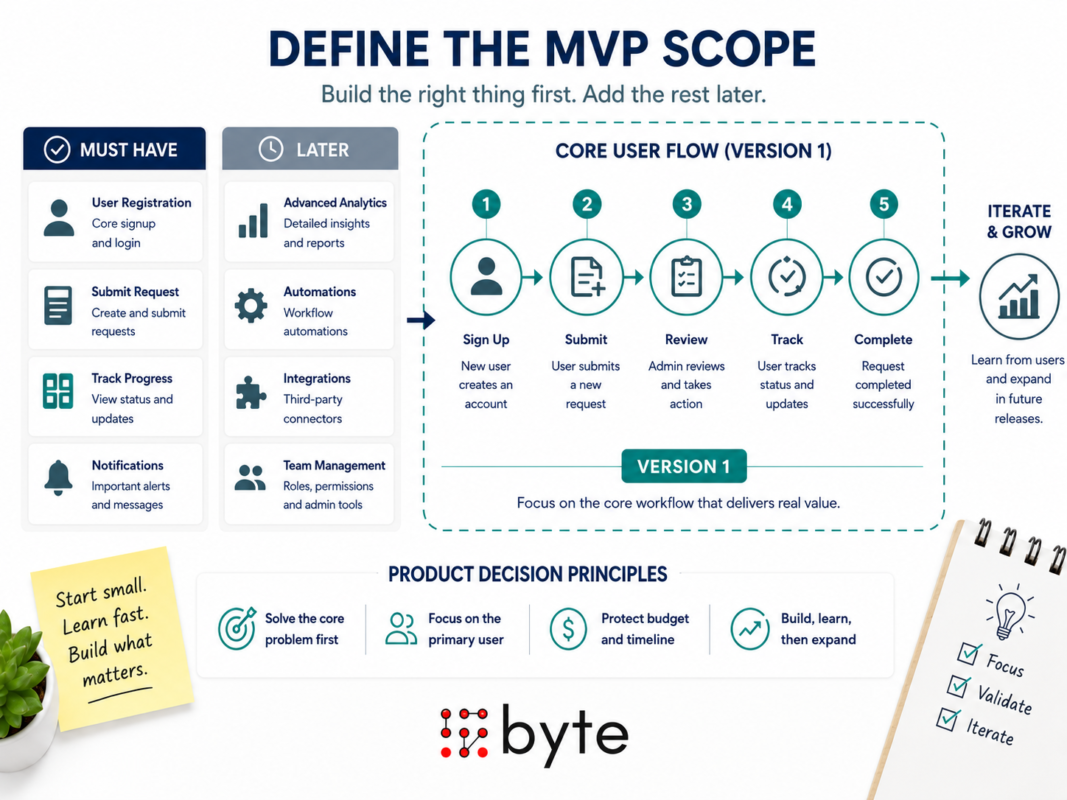
One of the biggest mistakes founders make is trying to build the full product too early.
A minimum viable product should not be a smaller version of every idea the founder has. It should be the simplest useful version that helps test the most important assumptions.
Before hiring a development team, founders should define what belongs in version one and what can wait.
A good MVP scope should answer:
- What must the product do on day one?
- What problem must it solve first?
- Which features are required for the core user flow?
- Which features can be added later?
- What can be done manually in the beginning?
- What needs to be automated now, and what can wait?
This protects the budget and keeps the development team focused.
An MVP is not about building less because the idea is small. It is about building intentionally because the business still needs to learn.
Define Milestones, Budget, and Ownership
Founders should avoid treating development as one vague project called “build the app.”
A stronger approach is to break the work into stages: discovery, product planning, wireframes, prototype, MVP development, testing, launch, and post-launch improvement.
Milestones help everyone understand what should happen next and what needs to be completed before moving forward.
Budget should also be discussed early.
The same product can usually be approached in multiple ways. A lean MVP may focus only on the core workflow. A more advanced version may include dashboards, automations, integrations, admin tools, reporting, and complex user permissions.
Both may be valid, but they serve different budget levels and business stages.
Founders should ask:
- What can we reasonably invest now?
- What must this version prove?
- Where can we simplify without weakening the product?
- What should be saved for phase two?
Ownership also needs to be clear.
A product is not just a visible app or website. It may include source code, design files, hosting, databases, domain access, admin accounts, repositories, third-party tools, analytics, payment systems, API keys, and documentation.
Founders should understand who owns and controls each part before development begins. Clear ownership reduces risk and prevents unnecessary dependency later.
Technology should become an asset for the business, not something the founder cannot control.
Define Maintenance and Success Metrics
Launch is not the end of a technology project.
It is the beginning of real-world use.
Once users begin interacting with the product, issues will appear. Bugs may need to be fixed. Workflows may need adjustment. Users may request changes. Security updates may be required. Hosting may need monitoring. Integrations may need support.
Founders should clarify how the product will be maintained after launch.
- Who will handle bug fixes?
- How quickly will issues be addressed?
- Who monitors hosting, backups, and security?
- How will user feedback be reviewed and prioritized?
Success metrics should also be defined before development begins.
Success should not be limited to “the product launched.” Launching matters, but it does not prove the product is working.
For a customer-facing product, success may mean signups, active users, completed transactions, retention, feedback, or revenue.
For an internal tool, success may mean time saved, fewer manual tasks, faster reporting, better visibility, fewer errors, or stronger team coordination.
For an MVP, success may mean validated demand, user feedback, proof of workflow, investor confidence, or evidence that the product should be expanded.
Technology should be measured by what it helps businesses achieve.
How Byte Advisory Helps Founders Plan Before Development
At Byte Advisory, we help founders think through product and technology decisions before development begins.
Our approach is practical. We look at the business model, user journey, product goals, workflow requirements, budget, timeline, and growth plan. From there, we help define what should be built now, what should wait, and how the product should be structured for the next stage.
For some founders, the right first step may be a lean MVP. For others, it may be a Lovable prototype, WordPress website, CRM workflow, custom internal system, mobile app, or web application.
In many cases, the strongest approach is staged: start with the core workflow, test with users, improve based on feedback, and expand once the business has more clarity.
The objective is not to build technology for the sake of technology. The objective is to create a product that supports the business, serves the user, and gives the founder a clearer path from idea to execution.
Final Thoughts
Hiring a development team is not just a technical decision. It is a product and business planning decision.
Before founders commit budget to development, they should define the business problem, core user, user flow, MVP scope, milestones, budget range, ownership structure, maintenance needs, and success metrics.
The clearer those pieces are before development begins, the easier it becomes to build with focus.
Founders do not need every answer. But they do need enough structure to guide the project, protect the budget, and help the development team make better decisions.
For startups and growing companies, the goal is simple: build what matters first, learn from the market, and create technology that can support the next stage of growth.
To discuss your product strategy, MVP scope, development roadmap, or technology planning before coding begins, contact Byte Advisory through our website at byteadvisory.com/contact/ or email us at [email protected].