

Many business plans are written for one event: raising capital, applying for financing, or presenting the company to an outside party. Once that event passes, the document is often filed away.
That misses much of its value.
A useful business plan should help leadership answer questions that matter whether investors are involved or not.
Who are we serving? What problem are we solving? Where should we focus first? What will growth require? Which resources do we need? What assumptions are we making about revenue, hiring, marketing, and operations?
These are business decisions.
When built around real operating assumptions, a business plan can help founders connect strategy with execution, clarify priorities, and make more informed decisions as the company grows.
A Business Plan Should Clarify the Business, Not Just Describe It
A weak business plan describes a company.
A useful one forces the company to make choices.
It is easy to say the business wants to grow, attract more customers, launch new products, or enter new markets. The harder work is deciding what those goals actually require.
For example:
- Which customer segment deserves the most attention?
- Which products or services should be prioritized?
- How will the company reach and convert customers?
- What resources are needed to deliver consistently?
- What should happen now, and what can wait?
Without that clarity, teams can begin operating from different assumptions.
Sales may pursue one type of customer while marketing speaks to another. Product teams may invest in features that do not support the commercial strategy. Hiring may happen before demand is strong enough to justify additional fixed costs.
Business planning creates a shared view of how the company is expected to operate and grow.
The objective is not to produce a long document. It is to create clarity around the decisions that matter.
Turn Growth Ideas Into Operating Assumptions
Growth goals often sound simple at a high level.
Increase revenue. Hire more people. Launch another service. Enter a new market. Spend more on marketing.
Each one creates operational requirements.
If a company wants to double revenue, for example, it should understand what needs to change to support that growth.
Will the current team have enough capacity? Will more sales or delivery staff be required? Can existing systems support a larger customer base? Will customer acquisition become more expensive? Does the company need additional working capital before new revenue is collected?
A useful plan turns broad ambition into assumptions that can be tested.
Instead of simply saying:
“We plan to grow quickly.”
management begins asking:
“What has to happen for that growth to be achievable?”
That shift makes strategy more practical.
Plans become more useful when growth expectations are connected to people, systems, spending, timelines, and measurable outcomes.
Connect Strategy With the Financial Model
Strategy and finance should not be developed separately.
The business plan explains where the company wants to go and why. The financial model tests whether the assumptions behind that strategy are economically realistic.
Suppose the company wants to expand its product, increase marketing, and hire additional staff.
The strategic plan should explain why those investments matter.
The financial model should show what they may do to revenue, operating costs, margins, cash requirements, and runway.
If the economics do not support the original plan, leadership has options.
The company may change the timing, reduce the scope, improve pricing, delay hiring, raise capital, or reconsider an initiative.
That does not mean the strategy has failed.
It means the planning process exposed a trade-off before resources were committed.
The business plan creates the strategic context. The financial model tests the economics.
That connection helps turn financial planning from an investor requirement into a management tool.
Identify What Has to Happen First
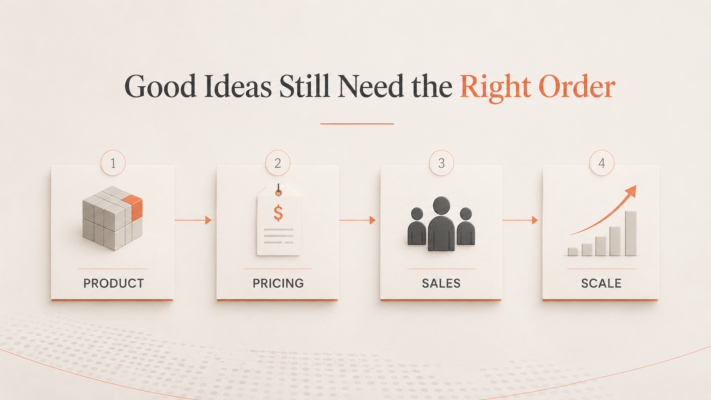
Good ideas still need the right sequence.
A company may want to improve its product, build a sales team, increase advertising, and enter another market. Trying to pursue everything at once can spread resources too thinly.
Some initiatives depend on others.
A product may need to be stable before marketing spend increases.
Pricing may need to be tested before a larger sales team is hired.
Reporting may need to improve before management can confidently assess profitability.
Cash flow may need to strengthen before the company adds more fixed costs.
The order matters because business decisions rarely happen in isolation.
Planning these dependencies helps teams understand what comes first, what can happen in parallel, and what should wait.
For a broader look at connecting business planning, product requirements, budgets, and execution, see From Idea to Execution: What Startups Need Before They Start Building.
Use the Plan to Test Important Decisions
A business plan should not only explain the current strategy. It should help leadership evaluate new opportunities.
A company considering a new market needs to look beyond potential revenue. Expansion may require additional marketing, staffing, partnerships, compliance, or changes to delivery.
A new product or service should be evaluated against customer demand, pricing, delivery capacity, margins, and the resources required to launch it.
An increase in headcount can improve capacity, but adding fixed costs before demand is stable may create pressure elsewhere in the business.
A pricing change can affect revenue, margins, positioning, customer expectations, and sales conversion at the same time.
The purpose of the plan is not to eliminate judgment.
It gives management a structure for considering the wider consequences of a decision before acting on it.
The same applies to raising capital. Funding should support a defined plan. Leadership should be able to explain what the capital will fund, which milestones it is expected to support, and what should improve as a result.
Keep the Plan Current
Markets change. Customers change. Costs change. Products evolve. Some assumptions hold, while others prove wrong.
The plan should change with the business.
That does not mean rewriting the entire document every quarter.
But the assumptions behind it should be reviewed periodically.
Management should revisit questions such as:
- Is the target customer still the right one?
- Are pricing and demand assumptions holding?
- Do hiring plans still match actual growth?
- Have funding requirements changed?
- Are the company’s priorities still in the right order?
A plan becomes less useful when it is followed simply because it was written months earlier.
Regular review helps management separate a strategy that still makes sense from one that needs to change.
Business Plans Help Create Alignment
As companies grow, decisions become more distributed.
Founders may no longer be involved in every sales conversation, product decision, marketing activity, or operational issue.
That makes alignment more important.
A clear plan gives teams a shared understanding of:
- Who the business serves
- What the company is trying to achieve
- Which products or services matter most
- How the company expects to grow
- What resources are required
- Which priorities come first
It does not replace judgment or day-to-day management.
It gives people a stronger framework for making decisions that support the same direction.
A Business Plan Is an Operating Tool
A business plan may help explain a company to investors, lenders, or partners.
But its value should not depend on whether someone outside the business reads it.
The strongest plans help management understand the business itself.
They clarify priorities, connect strategy with financial assumptions, identify dependencies, and create a framework for evaluating new opportunities.
A business plan cannot remove uncertainty.
It can make the assumptions behind a decision easier to see and easier to challenge before resources are committed.
That is what makes it useful as an operating tool, not just an investor document.
Through its strategic consulting services, Byte Advisory helps businesses connect strategy, financial planning, operations, technology, and execution so business goals can be translated into more practical plans.
For companies preparing for investment or external financing, Byte Advisory also provides capital raising support across business planning, forecasts, investor preparation, and related materials.
Building or updating your business plan? Speak with Byte Advisory about creating a practical plan that supports better internal decisions as well as external opportunities.
[email protected]
byteadvisory.com/contact/