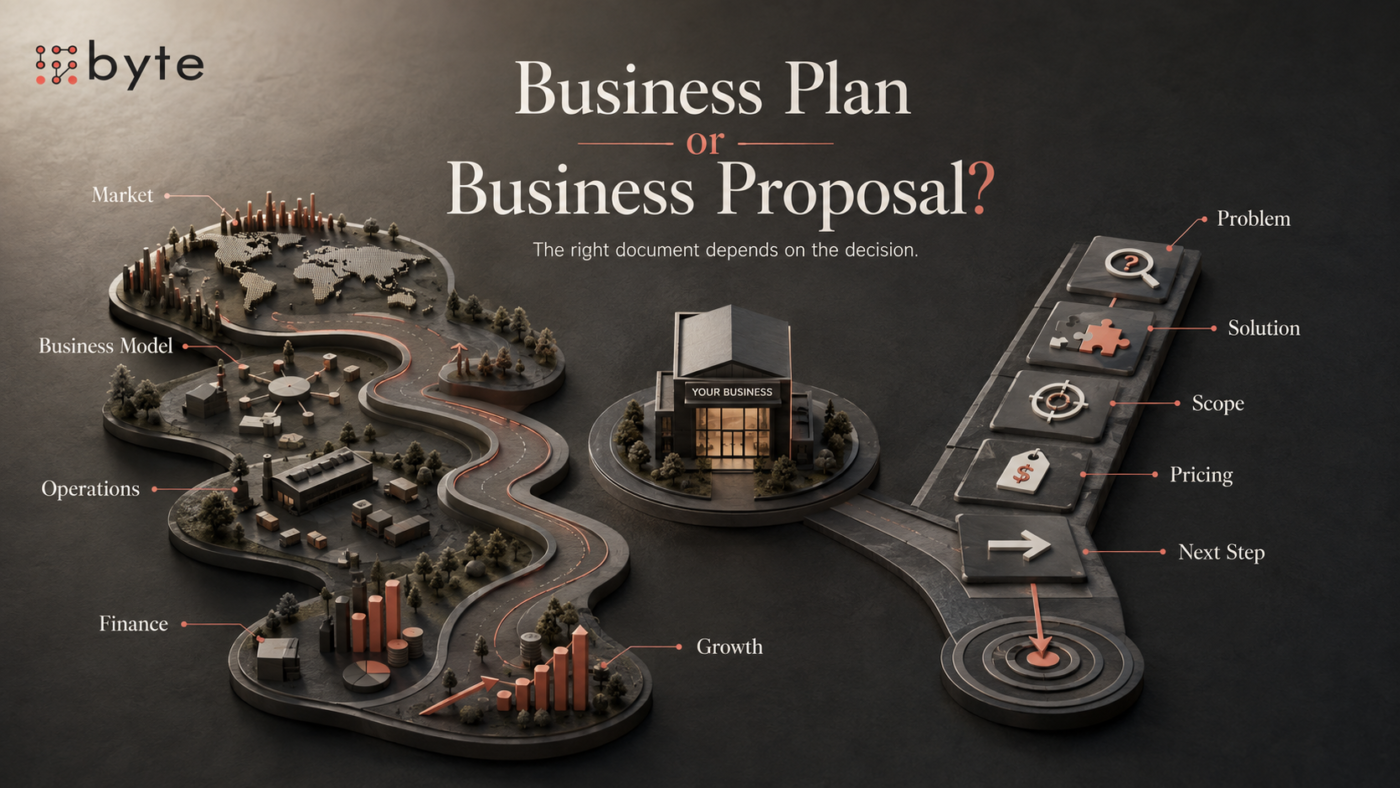
A business plan and a business proposal may contain some of the same information, but they serve very different purposes.
A business plan explains the business: how it works, where it is going, how it makes money, and what needs to happen for it to grow.
A business proposal presents a specific opportunity to a client, partner, or other decision-maker and explains what is being offered and what moving forward would involve.
The simplest difference is this: a business plan explains the business, while a business proposal presents a specific opportunity.
Understanding that distinction helps companies prepare the right document for the right audience.
A Business Plan Explains the Business
A business plan provides a structured view of the company itself.
It helps the reader understand what the business does, who it serves, how it makes money, what resources it needs, and how management expects it to grow.
Depending on its purpose, a business plan may include:
- Company overview
- Market opportunity
- Products or services
- Target customers
- Competitive landscape
- Business model
- Sales and marketing strategy
- Operations and team
- Financial assumptions
- Growth priorities
- Key risks
A business plan is broader than one project or transaction. It provides context around the business as a whole.
That makes it useful for founders, management teams, investors, lenders, and other stakeholders who need to understand how the company is expected to operate and grow.
A business plan explains how the business is expected to work.
A Business Proposal Presents a Specific Opportunity
A business proposal has a narrower purpose.
Rather than explaining the entire company, it usually focuses on a specific project, client requirement, partnership, contract, or commercial opportunity.
A technology company may prepare a proposal to build a platform. A consulting firm may prepare one for a prospective client. A service provider may submit one in response to an RFP.
A typical proposal may include:
- Opportunity or client background
- Understanding of the problem
- Proposed solution
- Scope and deliverables
- Project approach
- Timeline
- Responsibilities
- Pricing or commercial terms
- Assumptions
- Next steps
The reader is usually trying to answer one central question:
“Should we move forward with this offer?”
The proposal should make that decision easier.
Business Plan vs. Business Proposal: The Key Difference
The easiest way to compare the two is by looking at the decision each document supports.
| Business Plan | Business Proposal |
|---|---|
| Explains the overall business | Presents a specific offer or opportunity |
| Broader strategic focus | Narrower commercial focus |
| Used for planning, funding, lenders, or investors | Used for clients, projects, contracts, or partnerships |
| Covers business model, market, operations, strategy, and financial assumptions | Covers problem, solution, scope, deliverables, pricing, and timeline |
| Looks beyond one transaction | Usually tied to a specific decision |
| Supports long-term planning | Supports approval or agreement |
Both documents require clear thinking.
The difference is what that thinking is organized around.
When Do You Need a Business Plan?
A business plan is useful when someone needs to understand the company at a deeper level.
Common situations include:
- Starting a business
- Preparing for fundraising
- Applying for financing
- Entering a new market
- Launching a major business line
- Evaluating a business model
- Planning hiring and investment
- Aligning management around growth priorities
An investor, for example, needs more than a description of the product.
They may want to understand the market, revenue model, customer strategy, financial assumptions, resource requirements, and growth plan.
They are evaluating the business, not just one transaction.
A strong business plan should therefore connect the strategic story with the economics behind it.
The business plan creates the context. The financial model helps test whether the assumptions behind that context are realistic.
When Do You Need a Business Proposal?
A proposal is more appropriate when the decision involves a defined project, service, partnership, or commercial opportunity.
Imagine a company wants Byte Advisory to develop a new website.
The prospect does not need a detailed explanation of Byte Advisory’s entire business model. They need answers to practical questions:
- What is being proposed?
- What problem will it solve?
- What work is included?
- What will be delivered?
- How long will it take?
- What will it cost?
- What does the client need to provide?
- What happens next?
That is the role of a proposal.
The same principle applies to consulting, software development, marketing engagements, operational projects, and other professional services.
Choose the Document Based on the Decision
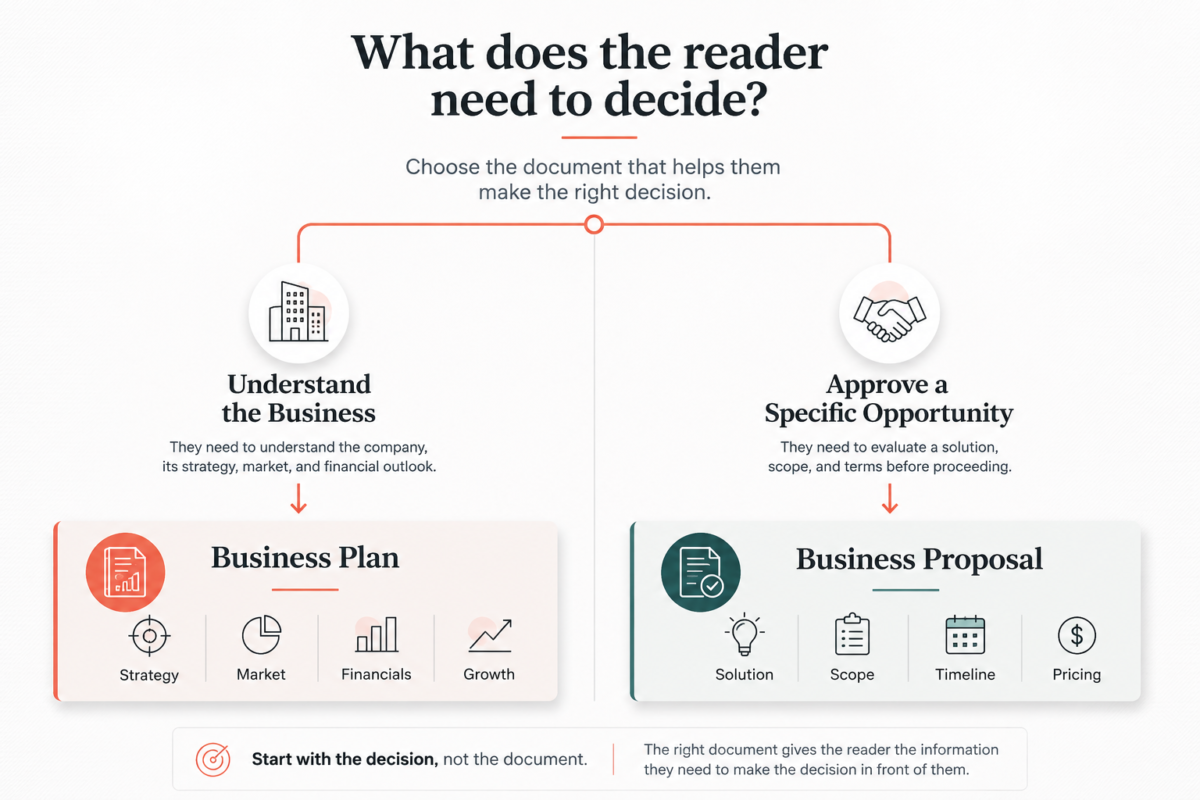
Businesses sometimes choose a document based on its name rather than what the audience actually needs.
A founder may send a full business plan to a prospective customer when the customer really needs a concise proposal.
A company seeking investment may prepare a service-style proposal when investors actually need to understand the broader business model, market opportunity, financial assumptions, and growth strategy.
Before preparing the document, ask:
- Who is reading it?
- What decision are we asking them to make?
- What information do they need before making that decision?
Those questions usually make the right format clearer.
Start with the decision, not the document
A Proposal Should Not Become a Company Brochure
A proposal should establish credibility, but it should not spend most of its time talking about the company presenting it.
The focus should quickly move to the recipient:
- What problem are they trying to solve?
- What outcome do they need?
- What are you recommending?
- What is included?
- How will the engagement work?
- Why does the proposed approach make sense?
The proposal is about the opportunity, not just the company presenting it.
A concise company introduction can establish credibility. The rest of the proposal should help the recipient evaluate the actual offer.
A Business Plan Should Not Become a Sales Pitch
The opposite problem can happen with a business plan.
If the document focuses only on sounding impressive, important assumptions may remain unclear.
A useful business plan should make questions around revenue, costs, resources, capital requirements, risks, and untested assumptions easier to examine.
It should explain not only why the business could succeed, but also what needs to be true for the plan to work.
That makes the document useful for decision-making rather than simply promotional.
Can a Business Need Both?
Yes.
A growing technology company may use a business plan to define its market, operating model, financial assumptions, growth priorities, and funding needs.
The same company may later use a business proposal to pursue an enterprise customer or strategic partnership.
Some information may overlap, but the documents should not simply be copies of each other.
The business plan provides a broader strategic context.
The proposal turns a specific opportunity into a clear offer.
Depending on the situation, a business may also need a financial model, pitch deck, investor memo, statement of work, or RFP response.
The right material depends on the audience and the decision being made.
Start With the Decision, Not the Document
A business plan and a business proposal are not interchangeable.
One explains how the business works and where it intends to go.
The other presents a specific opportunity and defines what moving forward would involve.
The strongest document is not necessarily the longest one. It is the one that gives the reader the information required to make the decision in front of them.
Byte Advisory helps businesses prepare business plans, proposals, financial models, investor materials, and other strategic documents around the decisions they need to make.
Not sure which document you need? Speak with Byte Advisory about preparing the right material for your next business, client, or investor opportunity.
[email protected]
byteadvisory.com/contact/