
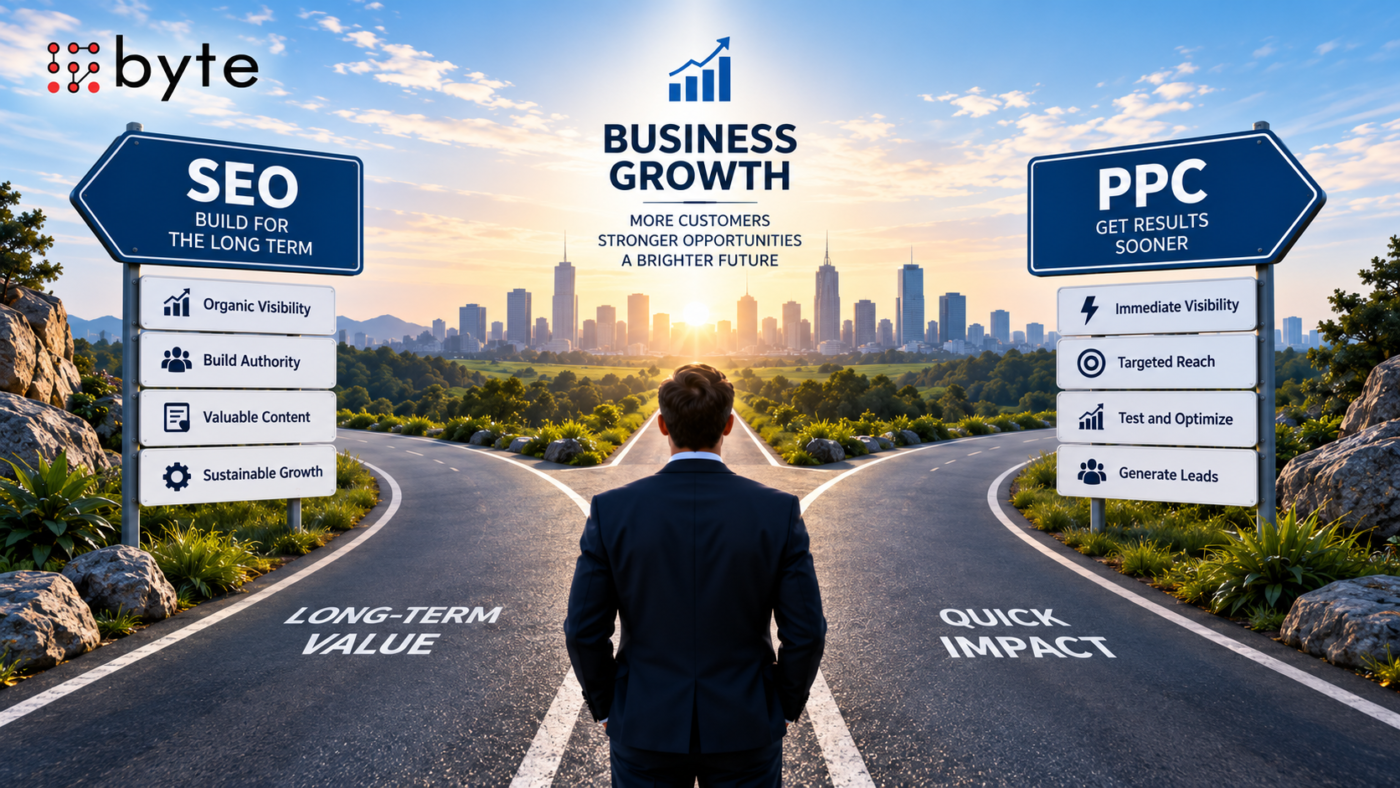
If your business wants more customers from search, two channels usually come into the conversation: SEO and PPC.
The difficult part is deciding where your business should invest first.
SEO can build organic visibility over time while PPC can put your business in front of potential customers much faster. Neither is automatically the better investment.
The right choice depends on what your business needs next.
Do you need leads quickly? Are customers already searching for your services? Is your website ready to convert traffic? Are you trying to build a long-term acquisition channel?
Those questions should come before deciding where to put the marketing budget.
SEO and PPC Are Different Investments
SEO: Building Organic Visibility
Search engine optimization focuses on improving a website’s ability to appear in relevant organic search results.
This can involve:
- Search-intent research
- Technical website improvements
- Service and product pages
- Useful content
- Internal linking
- Website structure
- Ongoing optimization
SEO requires investment, even though businesses do not pay for each organic click. The investment goes into building and improving the website and its ability to attract relevant search traffic.
The tradeoff is time.
SEO is generally a longer-term investment.
PPC: Paying for Immediate Visibility
Pay-per-click advertising allows businesses to pay for targeted search visibility based on selected keywords, audiences, locations, and other targeting options.
PPC can provide:
- Faster visibility
- Greater targeting control
- Campaign-level budget control
- Rapid testing
- Measurable advertising data
But paid visibility has a clear limitation:
When the advertising stops, the paid traffic generally stops with it.
So the comparison is not simply:
Free traffic vs. paid traffic
It is:
SEO → Build organic visibility
PPC → Purchase controlled access to search demand
When Should PPC Come First?
PPC may deserve priority when the business needs speed, testing, or immediate demand generation.
You Need Leads Soon
Imagine a service business with a sales target for the next 60 days.
Waiting for a new SEO strategy to build meaningful organic visibility may not fit that timeline.
A properly managed PPC campaign can put the business in front of the people searching for relevant services much sooner.
This can be useful for:
- New service launches
- Seasonal campaigns
- Local services
- Time-sensitive offers
- Businesses entering competitive markets
- Short-term lead-generation goals
But faster visibility does not automatically mean profitable results.
The offer, targeting, landing page, conversion process, and follow-up all matter.
You Want to Test an Offer
PPC can also be useful as a testing environment.
Suppose a company has two service packages and is unsure which message will attract qualified prospects.
Paid campaigns can help test:
- Headlines
- Offers
- Keywords
- Audiences
- Calls to action
- Landing-page messaging
If one message consistently generates better-quality inquiries, that insight can influence the broader marketing strategy.
PPC can provide both traffic and market feedback.
When Should SEO Come First?
SEO becomes more attractive when the business is willing to invest in long-term visibility and organic acquisition.
You Want Visibility That Builds Over Time
A well-developed SEO strategy can create pages and content that continue attracting relevant searches after they are published.
That does not make SEO free.
Research, writing, technical improvements, optimization, website development, and measurement all require resources.
The difference is what the investment is building.
PPC primarily pays for traffic. SEO invests in digital assets that can generate organic visibility over time.
Customers Research Before They Buy
Some purchases happen quickly.
Others involve several searches before a customer makes a decision.
A potential customer might search:
What does this service cost?
Then:
How does this service work?
Then:
What should I look for in a provider?
Each search represents an opportunity to provide useful information.
For businesses with longer consideration cycles, SEO can help build visibility throughout that research journey.
Your Website Needs a Strong Foundation
This is where businesses sometimes get the order wrong.
SEO cannot compensate for a website that makes it difficult for visitors to understand the business or take the next step.
Before investing heavily in traffic, ask:
- Can visitors quickly understand what we offer?
- Are important services easy to find?
- Does the content match what customers are searching for?
- Are calls to action clear?
- Is the website technically sound?
- Does the site work well across devices?
The same principle applies to PPC.
Sending more people to a weak website does not fix the website. It simply gives more people a chance to leave it.
Don’t Confuse Traffic With Growth
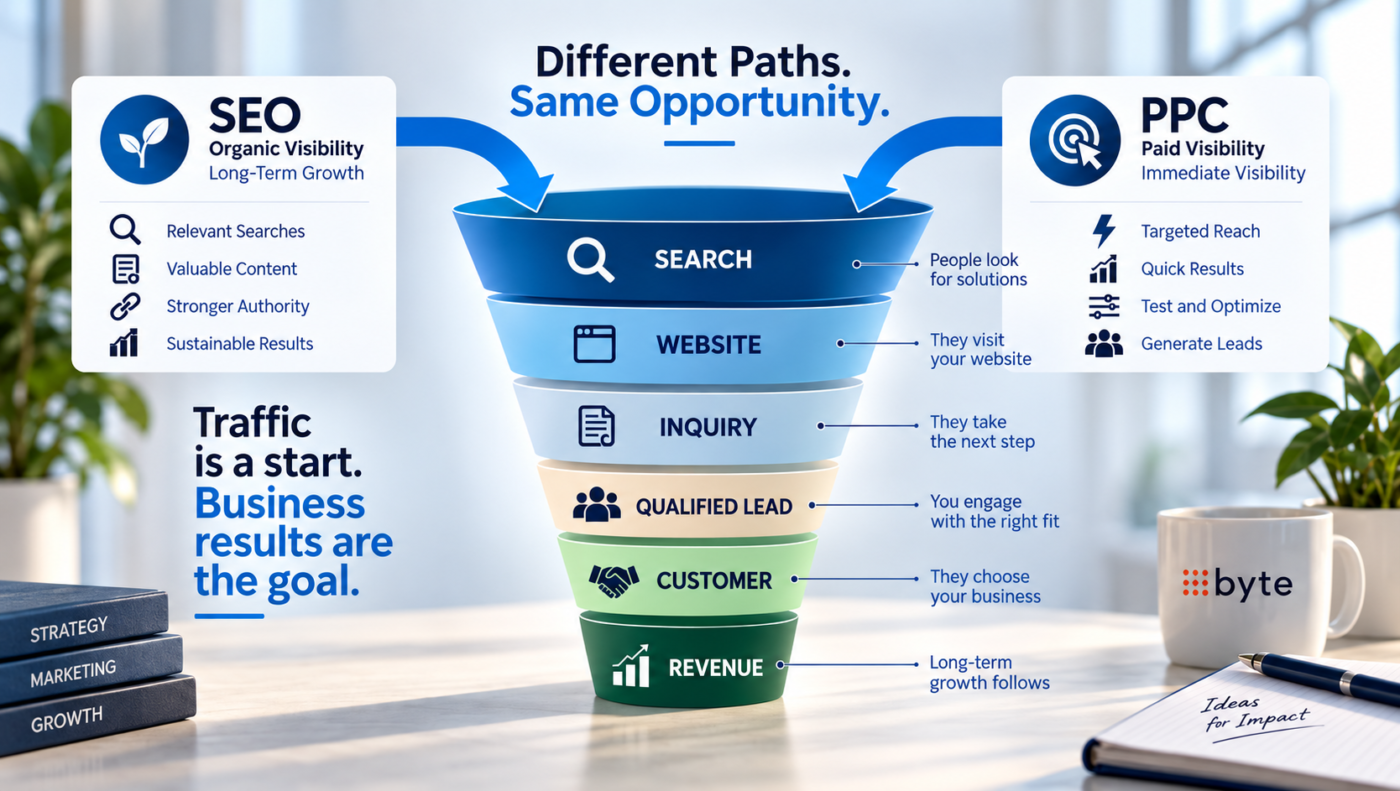
This may be the most important part of the decision.
Neither SEO nor PPC is the final objective.
The actual business journey is closer to:
Search → Website Visit → Inquiry → Qualified Lead → Opportunity → Customer → Revenue
A campaign can generate thousands of visitors and still fail to produce meaningful results.
The lesson applies to both channels:
More traffic is only valuable when the business can turn relevant traffic into meaningful outcomes.
Before increasing search traffic, understand what happens after someone clicks.
What Should You Measure?
The cheapest traffic is not necessarily the most valuable traffic.
For PPC
Look beyond clicks and impressions:
Ad Spend → Clicks → Leads → Qualified Leads → Customers → Revenue
Useful measurements include:
- Cost per click
- Conversion rate
- Cost per lead
- Qualified lead rate
- Customer acquisition cost
- Revenue generated
- Return on advertising spend
For SEO
Use the same business-focused approach:
Organic Visibility → Relevant Traffic → Leads → Qualified Leads → Customers → Revenue
Track:
- Organic visibility
- Relevant rankings
- Organic traffic
- Leads
- Qualified leads
- Conversions
- Customer acquisition
- Revenue influenced by organic search
The word relevant matters.
A website receiving 10,000 visitors who are unlikely to buy may be less valuable than one receiving 1,000 visitors who are actively looking for its services.
Before You Invest, Ask These Five Questions
Instead of asking whether SEO or PPC is better, ask:
1. How quickly do we need results?
If the business needs qualified leads within weeks or a few months, PPC may deserve priority.
If the business can invest for longer-term growth, SEO becomes more attractive.
2. Are customers actively searching for what we sell?
Strong search demand creates opportunities for both organic and paid visibility.
Limited search demand may require a broader marketing approach.
3. Is our website ready to convert traffic?
If visitors cannot quickly understand the offer or take action, fix the conversion foundation before scaling traffic.
4. What do we need to learn?
If the business needs quick feedback about keywords, offers, audiences, or messaging, PPC can provide useful testing data.
If the objective is long-term visibility around valuable customer questions, SEO may deserve more attention.
5. What outcome will justify the investment?
Define the business outcome before defining the marketing activity.
Is the goal:
- More qualified leads?
- More customers?
- Lower acquisition costs?
- More revenue?
- Greater market visibility?
The answer should influence where the budget goes.
Can SEO and PPC Work Together?
The choice does not always have to be one or the other.
A business can give each channel a different role.
For example, PPC can help test which keywords, offers, and messages generate qualified inquiries. SEO can then build longer-term visibility around topics and searches that prove valuable.
The result could look like:
PPC → Test and generate demand
SEO → Build organic visibility
Website → Convert visitors
Sales process → Turn opportunities into customers
Analytics → Measure what worked
The business does not necessarily need to spend equally on SEO and PPC.
It needs to allocate investment according to the role each channel is expected to play.
The Right Choice Can Change
The answer today may not be the answer six months from now.
A new business may use PPC to generate early demand while building its SEO foundation.
As organic visibility grows, the company may adjust its paid strategy toward higher-value searches.
An established business may use both channels, with PPC supporting immediate commercial opportunities while SEO captures demand earlier in the research process.
That is why SEO versus PPC should be treated as a resource-allocation decision, not a permanent choice between two competing channels.
Final Thoughts
SEO and PPC are not competing versions of the same strategy.
PPC can provide immediate search visibility. SEO can build organic visibility over time.
The better question is not:
“Which one is better?”
It is:
“What does our business need first?”
If the priority is immediate demand or testing, PPC may be the better starting point.
If the priority is long-term organic visibility, SEO may deserve greater attention.
If the business needs both, the two channels can work together, provided each has a clear role and performance is measured against actual business outcomes.
The best marketing investment is not necessarily the channel that produces the most traffic.
It is the channel that best supports the business result you are trying to achieve.
Byte Advisory helps businesses evaluate their marketing priorities, digital presence, and growth objectives so marketing activity can be connected to broader business goals.
Not sure whether SEO, PPC, or a combination makes sense for your business? Byte Advisory can help you evaluate where your next marketing investment should go.
[email protected]
byteadvisory.com/contact/