A business can have a strong product, active marketing, capable salespeople, and good technology, yet still struggle to create consistent growth. A strong business growth strategy depends not only on each of those areas performing well, but on them working together.
The problem is often not a lack of effort. It is that different parts of the business are moving in different directions.
Marketing may generate leads that sales does not follow up with consistently. A website may attract interest but send inquiries into a manual process. Technology may be implemented without a clear commercial objective. The company may increase demand before operations have the capacity to deliver.
Growth becomes harder when each function optimizes its own activity instead of supporting a shared business outcome.
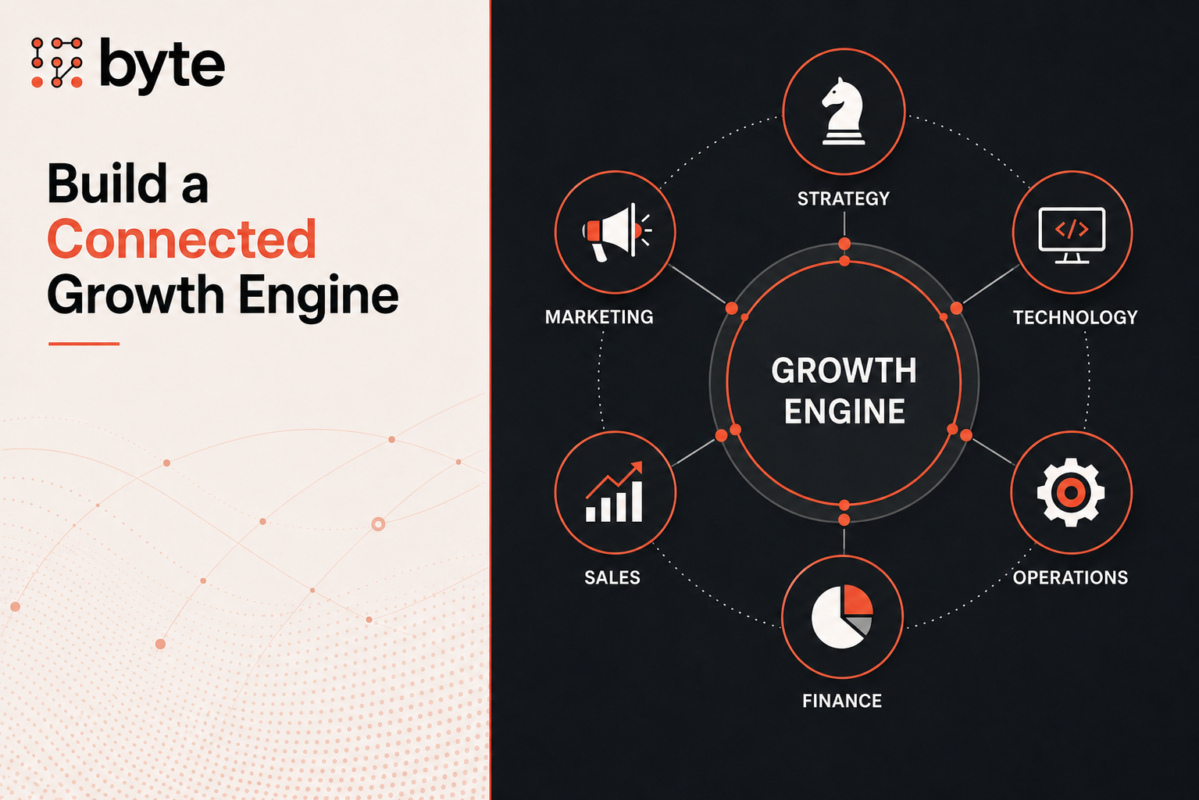
A stronger approach connects strategy, marketing, technology, sales, operations, and financial planning around the same priorities.
Growth is not one campaign. It is a system.
Growth Starts With Strategy
Before a business increases marketing spend, builds new technology, or expands its team, it needs to be clear about what it is trying to grow.
Goals such as “generate more leads,” “increase revenue,” or “enter a new market” provide direction, but they are not enough on their own.
A stronger strategy answers more specific questions:
- Which customers should the business prioritize?
- Which problem is the company best positioned to solve?
- Which products or services deserve the most attention?
- Why should customers choose the business instead of an alternative?
- Which channels are most likely to reach the right audience?
- What does successful growth actually look like?
Those decisions shape what comes next.
If the target customer is unclear, marketing becomes less focused. If the offer is poorly defined, the website may struggle to communicate value. If pricing does not fit the market, generating more leads may simply create more conversations that do not convert.
Strategy gives marketing, sales, and technology something specific to support.
This is why business planning should happen before execution becomes expensive. A clear plan helps the company decide where to focus, which assumptions need to be tested, and which priorities should come first.
Marketing Creates Demand, but Demand Is Only the Beginning
Marketing is often where companies look first when they want faster growth.
Paid advertising, content, SEO, social media, email campaigns, and outbound activity can all create visibility and generate opportunities.
But more activity does not automatically produce more revenue.
Once a potential customer responds, several things still have to work.
Does the landing page explain the offer clearly? Is the inquiry captured correctly? Does the right person receive it? How quickly does follow-up happen? Is the lead qualified? Can management see which campaigns are producing real opportunities?
A company can increase acquisition spending while still losing potential customers between those stages.
More leads do not necessarily mean more growth.
Marketing performance should therefore be connected to what happens after interest is created.
Traffic and clicks matter, but so do lead quality, conversion, revenue, and the customer journey that connects them.
Technology Should Connect the Customer Journey
Technology becomes valuable when it removes friction between customer interest and business outcomes.
For many businesses, the journey looks something like:
Website → Lead Capture → CRM → Follow-Up → Sales → Delivery → Reporting
When those stages are disconnected, teams often compensate with spreadsheets, manual updates, reminders, or duplicated data.
The right systems should make the process easier to operate.
A website should help customers understand the offer and take action. A CRM should provide visibility into leads and opportunities. Automation can support routing and follow-up. Reporting tools can help management see where opportunities are being created and where they are being lost.
Technology should not be introduced simply because another platform or feature is available.
It should solve a defined business problem.
For companies that have outgrown disconnected tools or manual workflows, Byte Advisory’s Custom Software Solutions can support systems designed around the way the business actually operates.
The objective is not more software. It is a more connected process.
Sales Must Be Ready to Convert Demand
Marketing creates the opportunity. Sales still needs a consistent process for converting it.
That requires clarity around:
- Lead ownership
- Qualification criteria
- Response time
- Follow-up
- Sales stages
- Pricing
- Pipeline visibility
If those areas are inconsistent, increasing marketing activity can expose the problem rather than solve it.
A company may believe it needs more leads when the real issue is slow response time. A campaign may appear weak when inquiries are being generated but follow-up is inconsistent.
Marketing and sales therefore need shared visibility.
Marketing should understand which leads turn into opportunities. Sales should understand where those opportunities came from and what attracted the customer.
Without that connection, it becomes much harder to identify what is actually driving growth.
Operations Must Deliver What Marketing Promises
Closing more customers creates another requirement.
The business has to deliver.
A company can improve marketing and sales performance, but growth becomes difficult to sustain if onboarding, service delivery, project management, customer support, or internal processes cannot keep pace.
As demand increases, the business may need:
- Additional team capacity
- Better onboarding
- Stronger project management
- Clearer workflows
- More reliable reporting
- Better systems or automation
If operational capacity does not grow with demand, service quality can begin to decline.
Projects take longer. Customers wait for responses. Teams become overloaded. Errors increase. Management spends more time solving exceptions.
At that point, growth creates pressure rather than strength.
An integrated growth strategy has to consider what happens after the sale.
The operating model has to support the promise marketing and sales made.
Financial Capacity Sets the Pace of Growth
Growth requires investment.
Marketing needs budget. Technology requires implementation and maintenance. New customers may require additional employees. Product development may create costs before it produces revenue.
A growth strategy is only useful if the business can finance the path between investment and return.
That means management needs to understand how growth initiatives affect cash flow, margins, headcount, and available resources.
Increasing marketing spend may be commercially sensible, but the company still has to fund the period between paying for acquisition and collecting revenue.
Hiring ahead of demand may prepare the business for growth, but it also increases fixed costs before additional revenue is certain.
The purpose of financial planning is not to prevent investment.
It is to help management determine how much the business can support, when the investment should happen, and which initiatives deserve priority.
Instead of asking only:
“What could help us grow?”
the business can ask:
“What should we invest in next?”
For a deeper look at connecting financial assumptions with product and growth decisions, link here to How Financial Models Help Startups Make Better Product and Growth Decisions once that article is published.
Measure the Whole Growth Engine
Different functions naturally track different metrics.
Marketing looks at traffic, leads, and campaigns. Sales tracks opportunities and closed business. Operations monitors delivery and capacity. Finance focuses on revenue, margins, and cash.
The connections between those measures often reveal more than any single metric.
A useful view of the growth engine might follow:
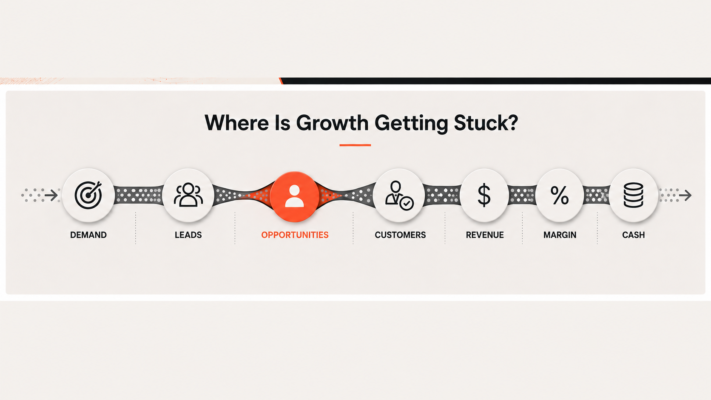
Demand → Leads → Qualified Opportunities → Customers → Revenue → Margin → Retention → Cash
That sequence helps management identify where performance is breaking down.
If traffic rises but leads do not, the offer or conversion process may need attention.
If leads rise but sales do not, qualification, pricing, follow-up, or sales execution may be the issue.
If revenue grows but margin or cash weakens, the economics of growth or working-capital requirements may need closer attention.
Looking across the full journey makes it easier to solve the right problem instead of optimizing one metric in isolation.
Find the Constraint Before Adding More Activity
When growth slows, the natural response is often to do more.
More advertising, more content, more salespeople, and more technology do not automatically solve the underlying problem.
If conversion is weak, increasing traffic sends more people into the same weak process.
If sales follow-up is inconsistent, more leads create a larger backlog.
If delivery capacity is already stretched, closing more customers may reduce service quality.
If cash is tight, expanding several initiatives at once may increase financial pressure.
The better question is:
Where is the growth engine currently constrained?
The answer may be marketing, but it could also be positioning, pricing, conversion, technology, sales execution, delivery capacity, or finance.
Once the constraint is clear, the next investment becomes easier to prioritize.
Growth becomes more efficient when the business improves the limiting part of the system instead of increasing activity everywhere at once.
Growth Works Better When the Pieces Work Together
- Sustainable growth rarely comes from one function working harder.
- Strategy determines where the company should compete.
- Marketing creates awareness and demand.
- Technology connects information and workflows.
- Sales converts opportunities into customers.
- Operations delivers the customer experience.
- Finance helps determine what the business can support.
Each function matters individually, but stronger results come from how they work together.
A business does not need every system, campaign, or process to be perfect before it grows. But the major parts of the customer journey and operating model should support the same direction.
That is the idea behind Byte Advisory’s multidisciplinary approach. By bringing together consulting, technology, finance, and marketing support, Byte helps businesses address growth as a connected operating challenge rather than a series of isolated projects.
Building your next stage of growth? Speak with Byte Advisory about aligning strategy, technology, marketing, and execution around the priorities that matter most.
byteadvisory.com/contact/