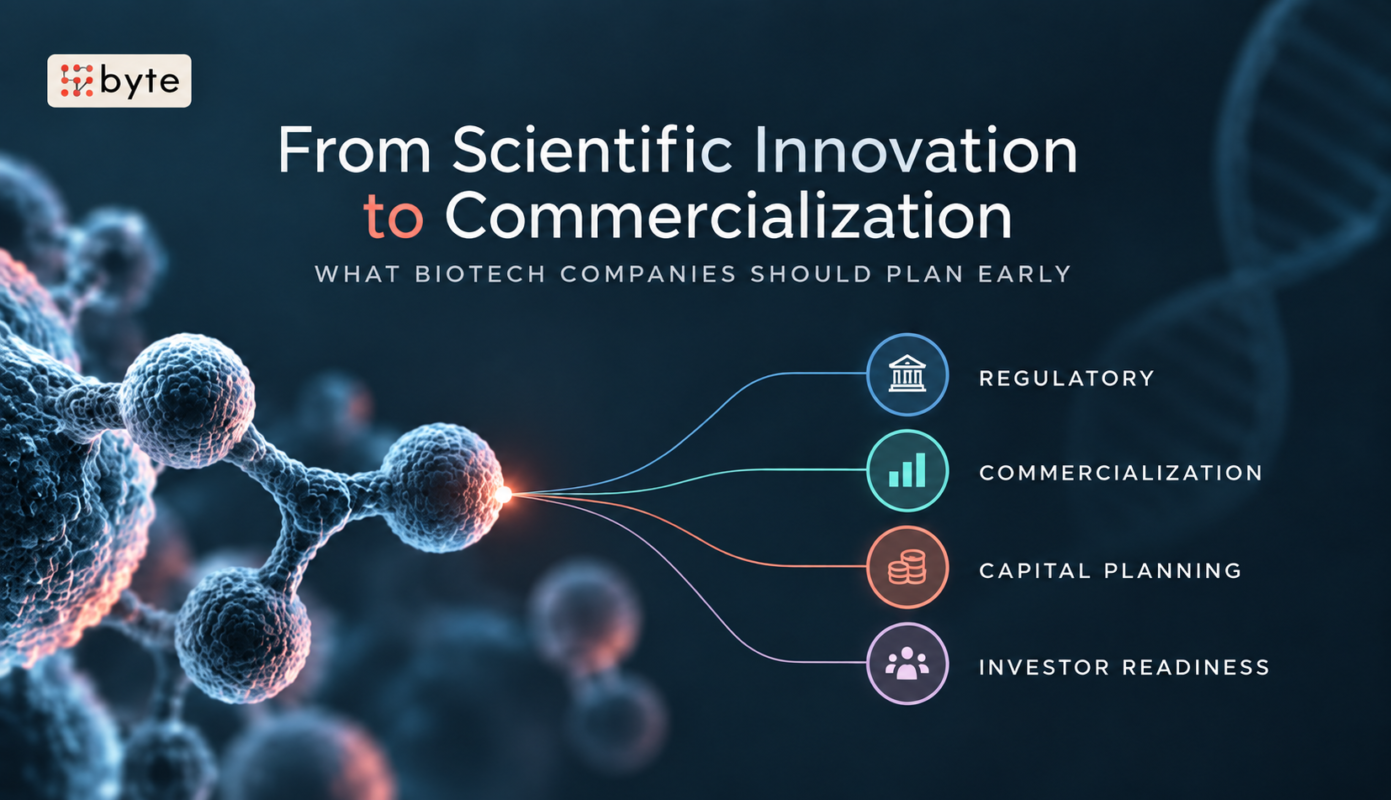
A promising scientific result can change more than a biotech company’s scientific thesis. It can change what the company needs to develop, validate, fund, communicate, and ultimately commercialize.
Consider a hypothetical biotech company developing a targeted cancer therapy. Early clinical data shows a stronger-than-expected response in patients with a particular biomarker.
Scientifically, that is an important finding.
Strategically, it may be just as important.
The company may now need to reconsider whether future testing should focus more heavily on that patient population, whether its regulatory strategy needs to evolve, whether the commercial opportunity is concentrated in that segment, and whether its existing capital is enough to reach the next milestone.
One result can create several new decisions.
That is where scientific innovation begins to intersect with commercialization.
A Scientific Milestone Changes More Than the Science
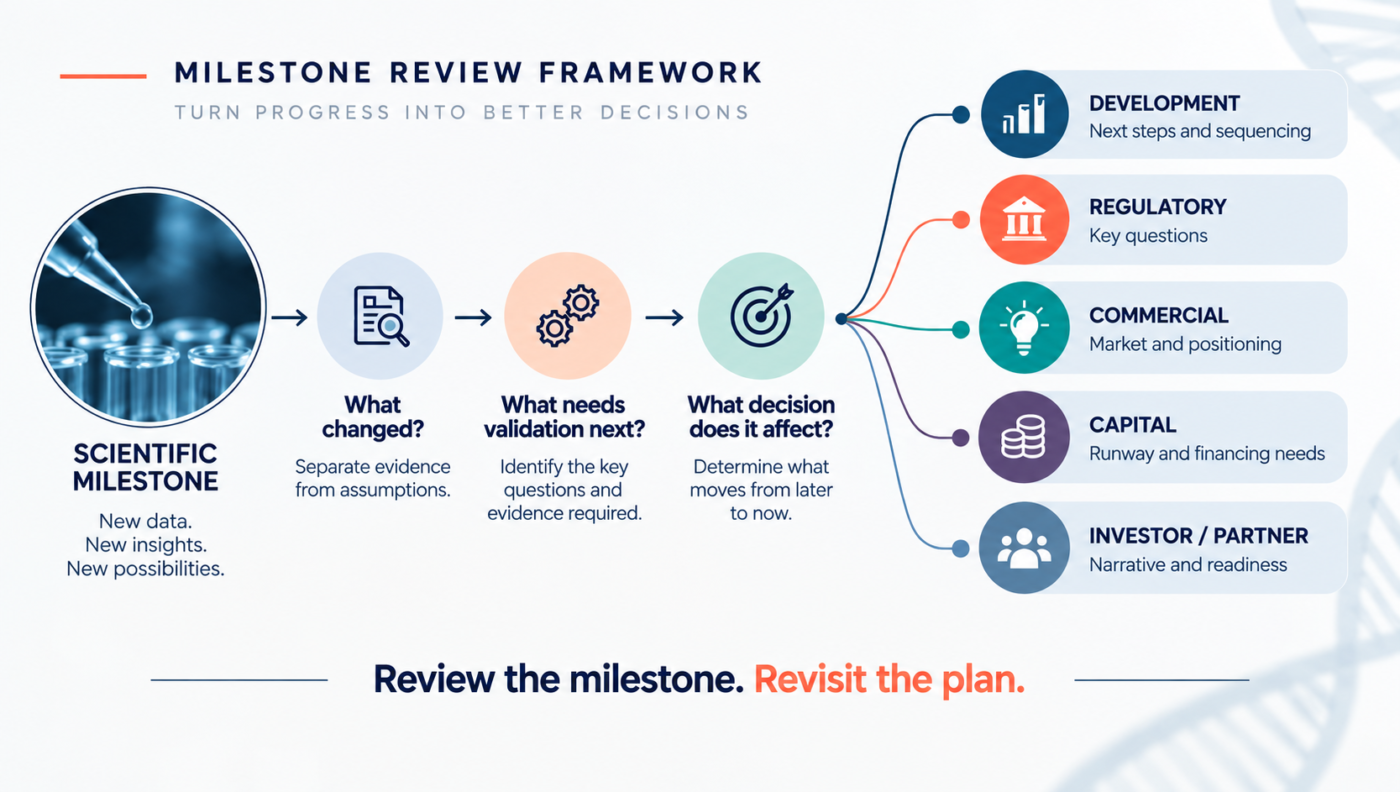
Biotech companies often organize development around milestones such as preclinical validation, proof of concept, clinical data, biomarker results, safety findings, or efficacy results.
But a milestone should not be treated as simply another point on a development timeline.
Each meaningful result should trigger a review of what happens next.
A stronger-than-expected result may open a new development path. A weaker result may require a change in the target population, study design, timing, or resource allocation.
Return to the cancer-therapy example.
If the strongest response appears in a defined biomarker population, the question is no longer simply:
“Did the therapy work?”
It becomes:
“What does this result change about the development strategy?”
That question can reach beyond the clinical program into regulatory planning, commercial positioning, manufacturing, partnerships, and financing.
Turn Evidence Into the Next Decision
A useful communication structure is:
State the Result → Explain Why It Matters → Define What It Enables → Show What Happens Next
For the cancer-therapy example:
Result: A stronger response appears in patients with a specific biomarker.
Why it matters: The biomarker may help identify a population in which the therapy has greater potential.
What it enables: The company may have an opportunity to refine its development strategy around that population.
What happens next: Additional evidence, regulatory input, trial planning, commercial assessment, and capital planning may all need to be revisited.
The point is not to assume that one encouraging result guarantees success.
It is to identify which next decisions the evidence now makes more important.
Test Commercial Assumptions While the Science Develops
Commercialization planning should not wait until the scientific program is complete.
As evidence develops, commercial assumptions should be tested against what the science is showing.
A therapy may initially target a broad patient population. New evidence may suggest that the strongest opportunity is concentrated in a narrower group.
For example, if a cancer therapy performs particularly well in patients with a specific biomarker, the company may need to reassess:
- How large is that patient population?
- How will those patients be identified?
- What competing treatments are available?
- What clinical benefit will matter to physicians and payers?
- Does focusing on this population strengthen or narrow the commercial opportunity?
The objective is not to build a perfect market forecast years before launch.
It is to ensure that the commercial thesis evolves with the evidence.
A scientific advantage becomes commercially meaningful only when the company understands where that advantage matters and to whom.
Bring Regulatory Questions Shape the Roadmap
Regulatory planning also needs to evolve as evidence develops.
Drug development involves different evidence and regulatory considerations across discovery, preclinical research, clinical development, review, and post-market stages.
A scientific milestone can therefore create a regulatory question that was less important before the result.
For example, a promising clinical signal may lead a company to consider whether its next study should focus on a specific biomarker-defined population, what additional evidence may be needed, or whether earlier regulatory engagement could help shape the development path.
The right response is not to assume what a regulator will decide.
It is to recognize when a regulatory question has become important enough to influence the roadmap.
That can help prevent expensive development decisions from being built around assumptions that should have been tested earlier.
Connect the Next Scientific Milestone to the Capital Required
Every development decision has a financial consequence.
Trial design affects costs. Enrollment requirements affect timelines. Manufacturing changes can require additional work and investment. A longer development path can extend the funding requirement.
Return to the cancer-therapy example.
If new evidence supports expanding development around a particular patient population, the company may need additional clinical sites, patient recruitment, testing, manufacturing, regulatory work, or other resources.
The question becomes:
What will it take financially to reach the next meaningful milestone?
A practical sequence is:
Scientific Result → Development Plan → Resources Required → Capital Need → Runway → Financing Decision
The company’s cash balance may not have changed when a scientific result arrives.
But the cost and timing of the next milestone may have.
That should trigger a financial review.
This is where financial modeling becomes useful. A model can help management test how changes in development timing, hiring, spending, or funding requirements affect the company’s runway and available resources. For a broader look at this connection, see How Financial Models Help Startups Make Better Product and Growth Decisions.
The goal is to connect the scientific roadmap with the capital required to execute it.
Keep the Investor Story Aligned With the Evidence
Investors need more than a promising scientific result.
They need to understand what has been demonstrated, what remains uncertain, what happens next, and what the next financing will enable.
The same scientific result may therefore need different emphasis depending on the audience.
| Audience | What They Need to Understand |
|---|---|
| Scientific collaborators | Evidence, limitations, and what should be tested next |
| Regulatory specialists | Development implications and evidence requirements |
| Investors | Milestones, risk, capital needs, and opportunity |
| Potential partners | Strategic fit, differentiation, and remaining validation |
| Commercial teams | Target segments, positioning, access, and market assumptions |
The underlying evidence should remain consistent.
The emphasis changes because the decision changes.
For investors, the important connection is between the scientific result, the next milestone, the capital required to reach it, and the remaining risks.
That same discipline applies to broader business planning. A clear plan helps leadership connect strategic priorities with resources, timing, and financial assumptions rather than treating those decisions separately. Business Plans Are Not Just for Investors: How They Support Better Business Decisions explores that broader planning connection.
Plan for More Than One Outcome
Biotech development rarely follows a perfectly linear path.
Planning should therefore consider what happens if the next evidence is stronger, weaker, or broadly consistent with expectations.
Stronger-than-expected evidence
The company may accelerate development or prioritize a particular patient population.
Expected evidence
The existing roadmap may continue with limited changes.
Weaker-than-expected evidence
The company may need to revisit the indication, study design, resource allocation, or capital plan.
The purpose is not to predict which scenario will occur.
It is to decide how the company would respond to each one.
That makes the development plan more flexible without treating every possibility as equally likely.
A Biotech Milestone Review Checklist
At the next important development milestone, ask:
- What did the result actually demonstrate?
- Which assumptions remain unproven?
- Does the next development priority change?
- Has a regulatory question become more important or time-sensitive?
- Does the commercial opportunity still hold?
- Has the capital requirement or runway changed?
- What needs to change in the investor or partner story?
The purpose is not to create another planning document.
It is to identify strategic gaps while there is still time to respond.
Commercial Readiness Develops With the Science
The path from scientific innovation to commercialization is rarely a clean handoff from research to business.
Scientific evidence affects development priorities.
Regulatory considerations can affect timing and evidence requirements.
Those changes can influence capital needs, commercial assumptions, partnerships, and investor communication.
Consider another example: a biotech company developing a biologic achieves promising clinical results, but its manufacturing process still needs to scale or change before later-stage development.
That is not simply a manufacturing issue.
It can affect validation work, supply timelines, development costs, and the capital required to reach the next milestone.
When the evidence changes, the assumptions around it need to be reviewed.
Biotech companies do not need every answer early.
They need a disciplined way to identify which questions the latest evidence has made important.
From Evidence to What’s Next
The strongest biotech planning does not treat scientific milestones as isolated events.
A meaningful result should prompt a broader review of what the company needs to develop, validate, fund, communicate, and commercialize next.
That does not mean moving ahead before the evidence supports it.
It means being prepared to respond when the evidence changes the opportunity.
The plan should change when the evidence changes.
That is how commercial readiness develops alongside the science.
Byte Advisory works with biotech and medtech companies on strategic planning, commercialization strategy, financial planning, investor-facing materials, and related strategic support.
Planning the next stage of a biotech opportunity? Speak with Byte Advisory about connecting scientific milestones with regulatory, commercial, capital, and investor-readiness decisions.
[email protected]
byteadvisory.com/contact/