
A hypothetical biotech company developing a targeted cancer therapy sees an encouraging signal in early clinical data: patients with a particular biomarker appear to respond better. The team now has several questions to resolve. Is the finding reliable? Should it influence the next study? How would a narrower patient population affect recruitment, testing, and commercial opportunities?
A biotech commercialization strategy should connect those questions with decisions about evidence, resources, and the route to market. Before committing to a revised plan, leadership needs a clear account of what the finding supports, what remains uncertain, and what to investigate next.
A Scientific Milestone Changes More Than the Science
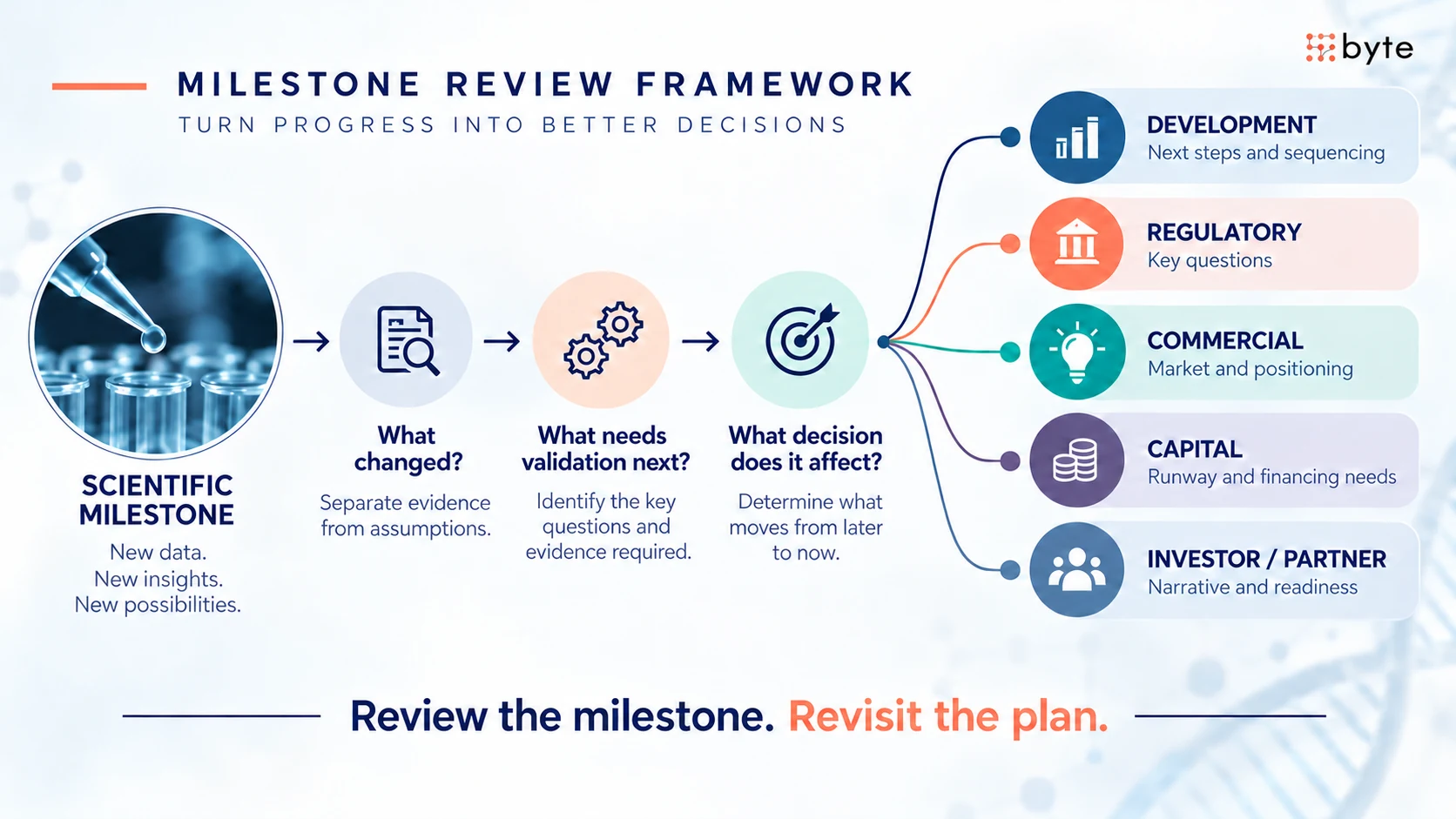
Start by establishing what the result actually demonstrated. In this example, the biomarker finding is exploratory. A response observed in a subgroup does not, by itself, establish that the treatment works better in that population.
The clinical and statistical teams need to review the analysis, its limitations, and the evidence needed to investigate the signal further. Management can then assess the implications without presenting a promising observation as a validated development strategy.
For management, the immediate task is to separate the work needed to investigate the signal from the larger spending commitments a change in development direction might create. The operating plan should reflect the outcome of that review.
Turn Evidence into the Next Decision
A milestone review should leave the team with a short decision record. It should identify the evidence available today, the outstanding questions, and the work required before the next commitment.
| Question | What the company should record |
|---|---|
| What changed? | An exploratory response signal appeared in a biomarker-defined subgroup. |
| What remains uncertain? | The strength of the finding, its reproducibility, and its relevance to future development. |
| What needs review? | The analysis, patient-selection implications, testing requirements, and commercial assumptions. |
| What happens next? | A defined review, a responsible owner, and a decision date before further resources are committed. |
This record also helps prevent teams from working to different versions of the plan. A commercial presentation should not describe the narrower population as the confirmed target while the development team is still assessing that proposal.
Test Commercial Assumptions While the Science Develops
The next commercial review should examine how the proposed population changes the opportunity. A narrower group might offer clearer differentiation, but it could also be harder to identify or reach.
For the cancer-therapy example, assess:
- How many patients could meet the proposed clinical and biomarker criteria?
- How would eligible patients be identified, and is the necessary testing accessible?
- Which treatments would compete for the same patients?
- What additional evidence would clinicians and payers need to evaluate the therapy?
A biotech commercialization strategy should distinguish the estimated patient population from the portion the company might eventually serve. Prevalence alone does not establish access, adoption, or demand.
Update the assumptions that the finding affects. Avoid rebuilding the entire market forecast around a result whose implications are still being evaluated.
Let Regulatory Questions Shape the Roadmap
If management is considering a biomarker-defined development path, qualified clinical and regulatory specialists should assess its implications before the next study plan is finalized.
Questions may include how patients would be selected, how the biomarker would be measured, what further evidence is needed, and whether regulatory engagement would help resolve a specific uncertainty.
Exploratory findings should remain clearly distinguished from evidence supporting a planned patient-selection approach. A company should not assume that an encouraging subgroup result establishes an acceptable trial design or predicts approval.
Record which questions could change the roadmap and when answers are needed. That gives the team a basis for sequencing work while preserving the distinction between business planning and specialist clinical or regulatory judgment.
Connect the Next Scientific Milestone to the Capital Required
The financial effect depends on what the company decides to do next. A focused population could change recruitment assumptions, testing costs, site requirements, or the time needed to gather further evidence. It should not automatically be modeled as a cheaper development path.
The financial part of a biotech commercialization strategy starts with a revised work plan. Identify additional activities, their dependencies, expected payment dates, and which existing commitments continue regardless of the decision.
For this company, management might compare continuing the current plan while investigating the signal with a proposal that requires further validation before the next study. Each option needs its own timing and cost assumptions.
Byte Advisory’s article on how financial models support product and growth decisions explains how changed operating assumptions can affect available resources. Here, the model should show what each development option would require and when funding decisions would become necessary.
Keep the Investor Story Aligned With the Evidence
Investor materials should explain the observation, its limitations, and the purpose of the next work package. They should also distinguish the current development plan from an alternative under review.
If a narrower target population remains under review, say so in the presentation. Explain what the next analysis will test and which decision the requested funding would support. That gives investors a clearer view of both the opportunity and the uncertainty.
The biotech commercialization strategy, financial model, and presentation should use consistent assumptions about the proposed population, development timing, and milestones. Where uncertainty remains, show it rather than allowing different documents to imply different levels of confidence.
Plan for More Than One Outcome
The next analysis may strengthen the biomarker hypothesis, weaken it, or leave the company needing more evidence. Agree in advance what each outcome would prompt management to review.
Stronger evidence could support evaluating a focused development proposal. Inconclusive evidence might justify a limited additional work package. Weaker evidence could lead the team to reconsider the hypothesis while reassessing the existing program on its own merits.
Management should agree these planning responses with the relevant specialists. Identify which decisions depend on the next evidence review and which commitments can wait until it is complete.
Keeping these dependencies visible also makes the business plan more useful for internal decisions, rather than letting it become a separate investor document.
A Biotech Milestone Review Checklist
Before approving the next work package, confirm that the team has:
- Recorded the result and its limitations.
- Identified the assumptions it could change.
- Assigned clinical, regulatory, commercial, and financial reviews where needed.
- Updated the relevant timeline and cost assumptions.
- Set a decision date and identified commitments that can wait.
- Checked that investor and partner materials reflect the same evidence.
From Evidence to What’s Next
For the hypothetical company, a useful milestone review ends with a defined next step: investigate the biomarker signal, identify what would support changing the plan, and budget the work needed to reach that decision.
A biotech commercialization strategy stays useful when its assumptions can be traced to evidence and its next commitments have clear conditions. That discipline helps leadership respond to new findings without treating every promising result as a reason to accelerate spending.
Byte Advisory supports commercialization planning, financial analysis, and investor-facing materials that connect technical information with business decisions. To discuss the planning and communication support your next milestone requires, speak with Byte Advisory.