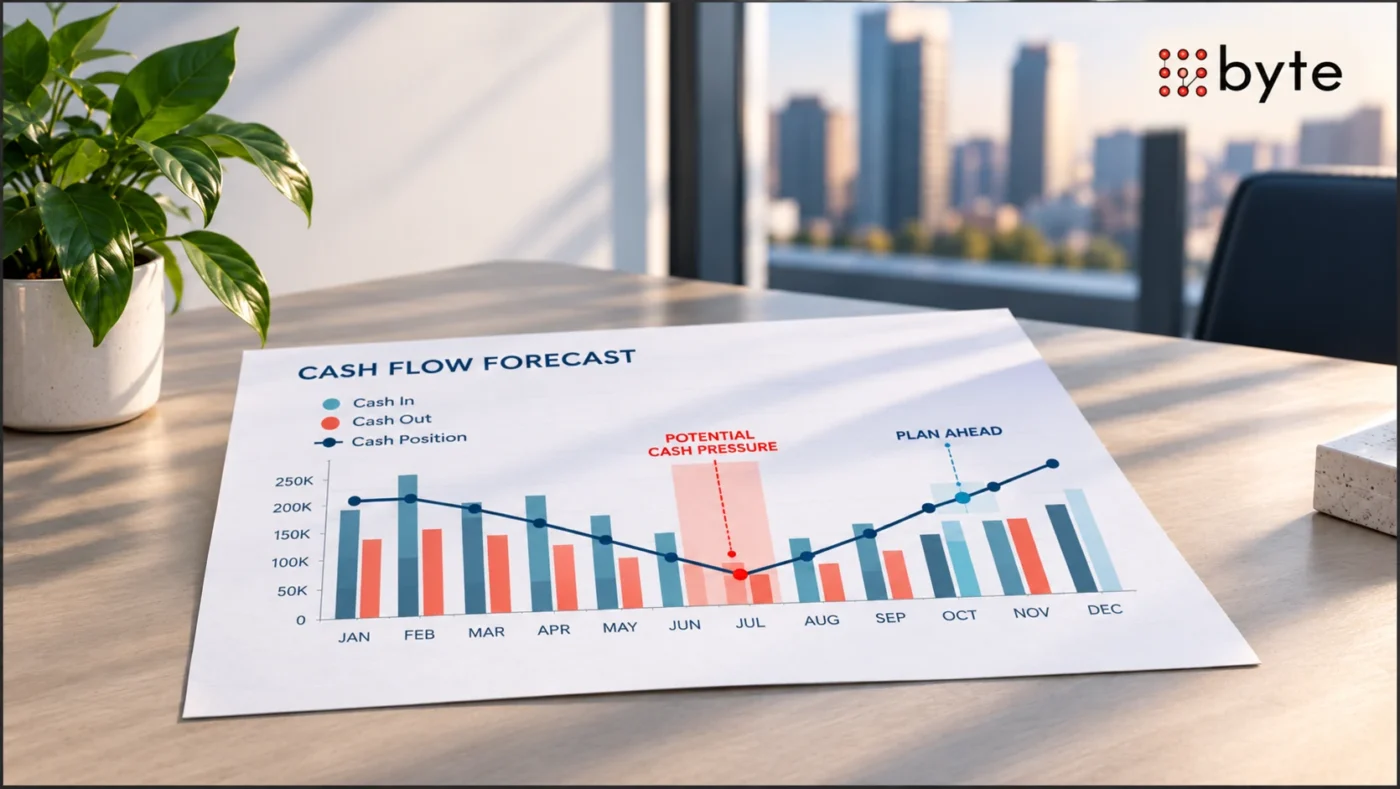
Consider a business with $50,000 in the bank. Next week’s payroll is covered, and it expects to finish the month with $42,000. That sounds comfortable until the owner checks the payment calendar: supplier bills fall due before most customer receipts arrive.
Cash flow forecasting for small business helps reveal those gaps before payments become urgent. A useful forecast shows when money is expected to move, how low the balance could fall, and which decisions need attention now.
Start with a payment schedule you can check and update. A spreadsheet is enough if the dates and amounts have a sound basis.
Choose the Period Your Decisions Require
A cash flow forecast estimates future cash receipts and payments. For each period, the calculation is:
Opening cash + expected receipts − expected payments = forecast closing cash.
The closing balance becomes the next period’s opening balance.
A rolling 13-week forecast is a practical option for monitoring near-term commitments. A monthly view extending across the next year can support hiring, seasonal planning, and larger purchases. Choose the detail around the decisions: weekly columns help when payroll and customer payments fall on different dates; monthly totals help with longer-term planning.
For a broader model that connects spending choices with growth assumptions, see Byte Advisory’s guide to how financial models help startups make better product and growth decisions.
Establish an Opening Balance You Can Reconcile
Use a clear cut-off date. Reconcile the relevant bank accounts and check pending payments, outstanding checks, and receipts still clearing. Record each item once, either in the opening position or as a future movement, according to the forecast’s cut-off method.
Identify restricted funds separately so they are not treated as available for general spending. Transfers between accounts included in the forecast should not inflate total receipts or payments.
An undrawn credit facility belongs on a separate funding line. Show an expected draw only when its timing and access conditions support the assumption. A pending application is not available cash.
Cash Flow Forecasting for Small Business: Use Real Payment Dates
For receipts, begin with outstanding invoices. Check due dates against recent payment behavior, unresolved disputes, and any collection commitments. Forecast large customers individually when one delayed payment could change the result materially.
Then add expected receipts from future work. Allow time for delivery, invoicing, and collection. Keep these receipts separate from existing receivables so the same sale does not appear twice. Recurring revenue also needs a collection date; the revenue figure alone is insufficient.
For payments, gather payroll dates, supplier invoices, tax payments, loan repayments, rent, subscriptions, and planned purchases. Include cash commitments such as equipment purchases and owner distributions even when they do not appear as equivalent expenses in the period’s profit-and-loss statement.
Record the expected cash amount, including applicable taxes, consistently. If a gross payroll figure already includes employee withholdings, allocate that total across payment dates rather than adding the withholdings again.
Cash flow forecasting for small business also needs evidence behind uncertain dates. A note such as “customer expects to pay after approval on the 18th” gives the next reviewer something to verify. “Sales should improve” does not explain a receipt.
Check the Cash Low Point, Not Just Month-End
Consider an illustrative business with $50,000 of opening cash, $35,000 of expected receipts, and $43,000 of scheduled payments over four weeks.
| Cash movement | Week 1 | Week 2 | Week 3 | Week 4 |
|---|---|---|---|---|
| Opening cash | $50,000 | $30,000 | $18,000 | $25,000 |
| Customer receipts | $0 | $5,000 | $10,000 | $20,000 |
| Scheduled payments | ($20,000) | ($17,000) | ($3,000) | ($3,000) |
| Closing cash | $30,000 | $18,000 | $25,000 | $42,000 |
The month-end balance is $42,000, but Week 2 ends at $18,000. Suppose management has chosen a $20,000 minimum operating balance for this example. The forecast shows a $2,000 gap against that buffer before collections restore the balance.
That buffer is a management assumption, not a universal requirement. Set it around the business’s obligations and uncertainty. The example includes no financing or other cash movements; a real forecast must include all relevant payments and receipts.
Check dates within a week when the balance is tight. If payments leave before receipts arrive, the actual low point could be below the weekly closing figure.
Test a Specific Delay
Move the $5,000 receipt expected in Week 2 to Week 4, leaving everything else unchanged. Week 2 now closes at $13,000, which is $7,000 below the assumed buffer. Week 4 still closes at $42,000.
The monthly total has not changed, but the business has less room to meet commitments along the way.
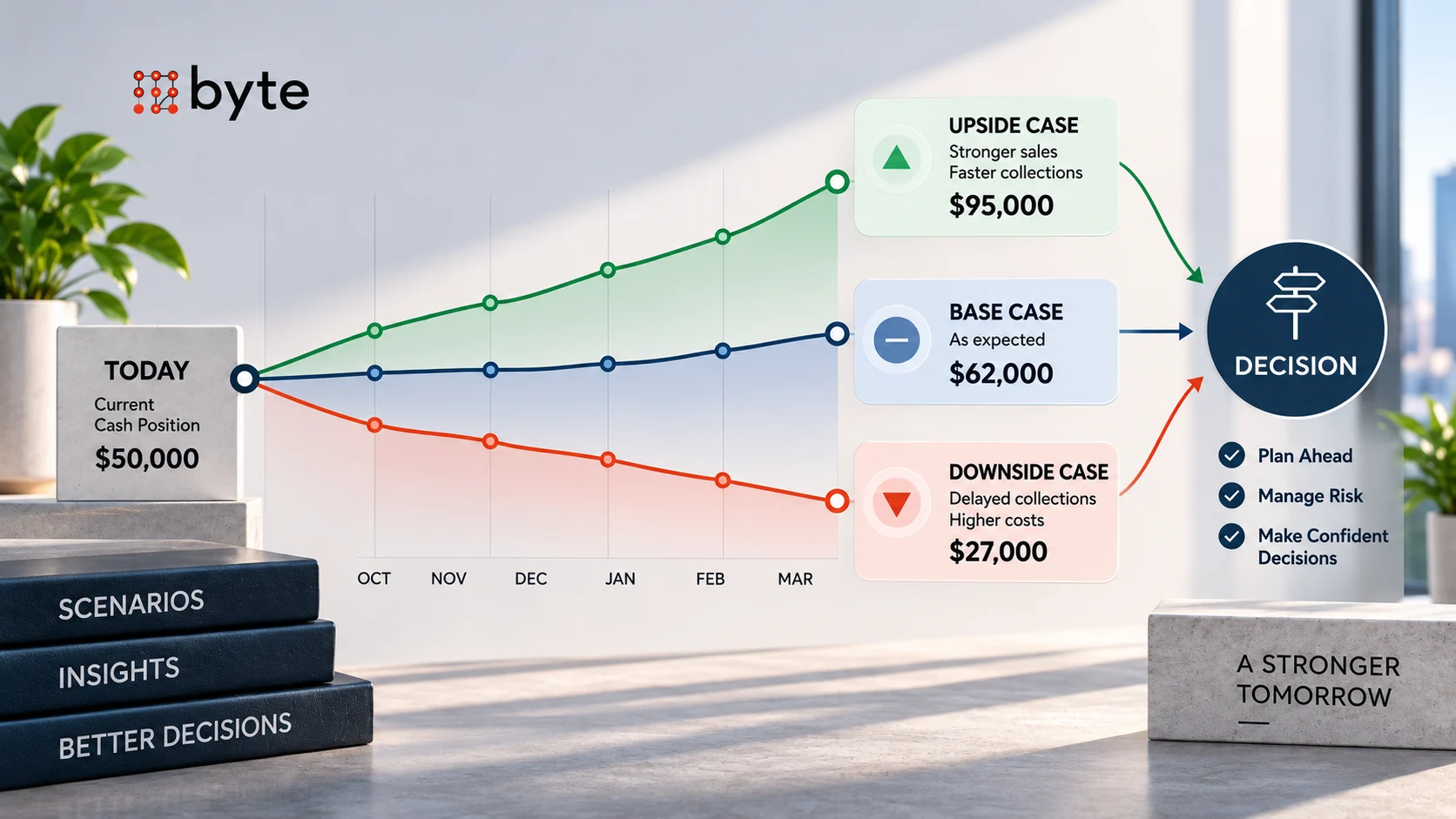
Cash flow forecasting for small business is more useful when scenarios change identifiable assumptions. Test a disputed invoice, a delayed project start, or an equipment deposit separately before combining them into a downside case.
Stronger sales need testing too. Additional orders may require materials or staff payments before their cash arrives. Show both sides of the change rather than simply increasing receipts.
Assign an Action Before the Gap Arrives
In the example, the immediate task is to confirm collection timing and review commitments falling before that receipt. Assign someone to contact the customer, check any invoice dispute, and report back before the payment run.
Where terms permit, management might stage a discretionary purchase or negotiate a supplier payment date. Financing may be an option, but its availability, cost, and repayment must be assessed. Do not make a forecast balance by quietly moving obligations past their due dates.
Hiring and expansion decisions need the same discipline. Enter the proposed commitment, test its effect on the low point, and decide what funding or customer evidence is required before proceeding. Byte Advisory’s article on using business plans to support better decisions explains how these choices fit into the wider operating plan.
Review Actual Results and Roll the Forecast Forward
Give one person responsibility for maintaining the forecast. Name the people responsible for supplying the figures for collections, payroll, purchasing, and planned spending.
At each weekly review:
- Replace the completed week’s estimates with actual cash movements and reconcile the closing balance.
- Explain material differences, separating timing changes from changes in total value.
- Move a delayed receipt to its revised expected date without counting it again.
- Update remaining assumptions and add another week to retain the planning horizon.
Keep the previous version. Otherwise, overwriting estimates remove the evidence needed to understand why cash differed from expectations.
Recurring misses may expose an operating problem. If invoices regularly go out late, the billing handoff needs attention as well as the forecast. Building a Growth Engine: How Strategy, Technology, and Marketing Work Together explores the wider connection between business functions and execution.
Reliable cash flow forecasting for small business gives management a date, an amount, and time to act. The $42,000 month-end figure becomes more useful once the owner can also see the Week 2 pressure and who is addressing it.
Byte Advisory helps businesses connect financial forecasts, cash planning, and operating decisions through its financial consulting services. To discuss a practical forecast for your business, contact us: