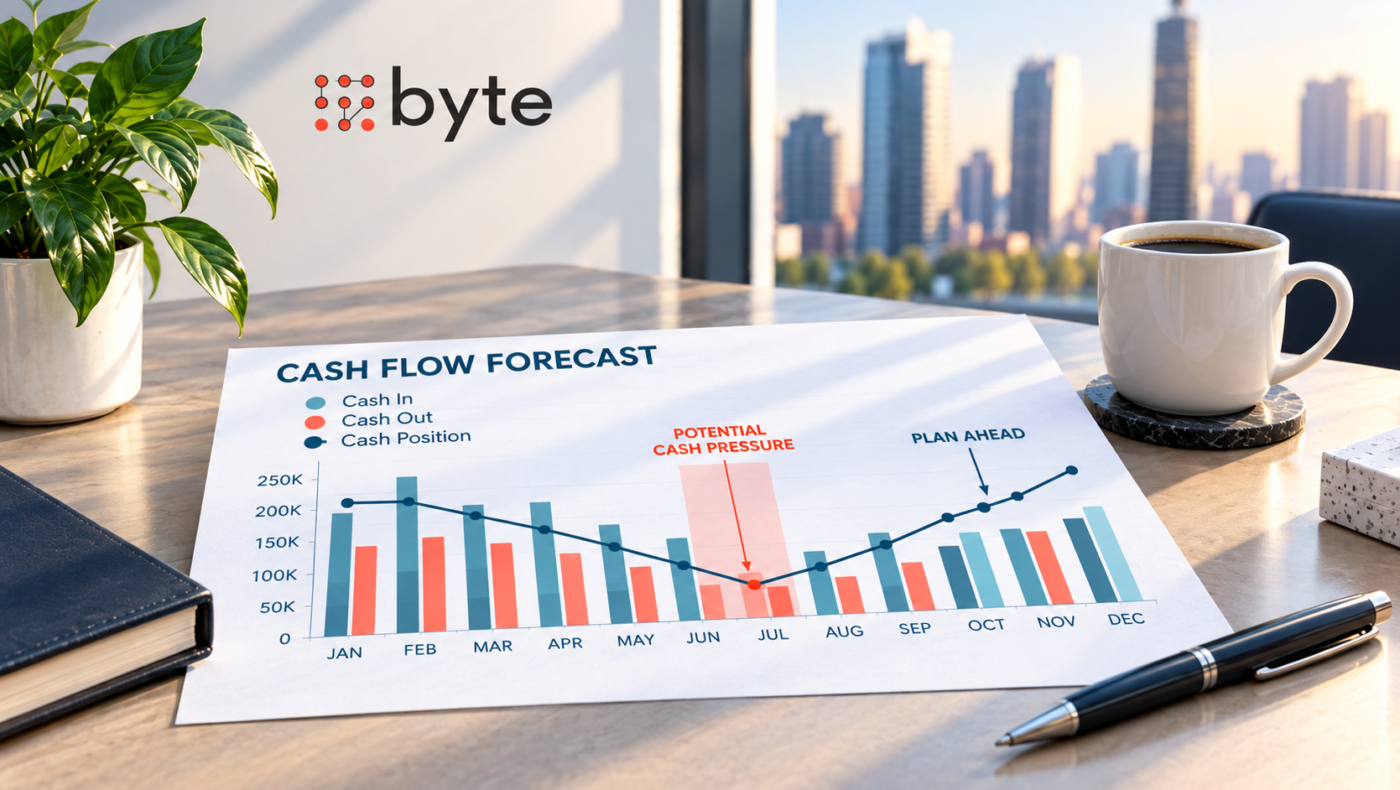
A business can be profitable on paper and still struggle to pay its bills.
That can happen when cash timing and business activity do not line up.
A customer may owe the business $20,000, but if payment is not expected for another 45 days, those funds cannot cover next week’s payroll. A large new contract may increase revenue while also requiring additional hiring, inventory, equipment, or other spending before the customer pays.
This is why cash flow forecasting matters.
A useful cash flow forecast helps a business understand when cash is expected to come in, when it is expected to go out, and when cash could become tight.
It does not need to predict the future perfectly. It needs to give the business enough visibility to make better decisions.
What Is a Cash Flow Forecast?
A cash flow forecast estimates a business’s expected cash inflows and outflows over a future period.
The basic calculation is:
Opening Cash + Expected Cash Inflows − Expected Cash Outflows = Expected Ending Cash
For example:
Opening cash: $50,000
Expected collections: +$35,000
Expected payments: −$43,000
Expected ending cash: $42,000
The formula is simple. The assumptions are where the real work begins.
A useful forecast focuses on when cash is actually expected to move, not simply when revenue or expenses are recorded.
Start With Your Actual Cash Position
Before forecasting the future, establish where the business stands today.
Start with the cash currently available across relevant business accounts.
Then identify obligations that are already known, such as:
- Payroll
- Rent
- Vendor payments
- Taxes
- Loan payments
- Insurance
- Software subscriptions
- Planned equipment purchases
This gives you a reliable starting point.
If the opening cash balance is wrong, everything that follows will be built on the wrong number.
Separate Cash Inflows from Cash Outflows
Next, identify what you expect to receive and what you expect to pay.
Cash inflows may include:
- Customer payments
- Accounts receivable collections
- Recurring revenue
- Financing
- Investment
- Other business income
Cash outflows may include:
- Payroll
- Supplier payments
- Rent
- Taxes
- Debt payments
- Software and operating expenses
- Equipment purchases
- Other capital expenditures
Do not simply copy numbers from the profit-and-loss statement.
The purpose of a cash flow forecast is to understand cash timing.
That distinction matters.
Revenue Is Not the Same as Cash
One of the most important concepts in cash flow forecasting is understanding the difference between a sale and a cash receipt.
Imagine a business completes a $20,000 project in September and invoices the customer.
The business may record $20,000 of revenue in September.
But if the customer pays in October, the business does not receive cash until then.
The sequence is:
Sale → Invoice → Customer Payment → Cash Received
A cash flow forecast needs to focus on the final step.
This becomes particularly important for businesses that offer customers payment terms of 30, 45, or 60 days.
If customers regularly pay late, the forecast should reflect that pattern rather than assuming every invoice will be collected exactly on time.
Build the Forecast Month by Month
For many small businesses, a rolling monthly forecast is a practical starting point.
| Cash Flow | October |
|---|---|
| Opening cash | $50,000 |
| Customer collections | +$35,000 |
| Payroll | −$20,000 |
| Vendor payments | −$15,000 |
| Taxes | −$5,000 |
| Other expenses | −$3,000 |
| Expected ending cash | $42,000 |
The $42,000 ending balance is important, but it is not the only number that matters.
The business should also ask:
What happens next month?
If November includes a major tax payment, equipment purchase, or payroll increase, that $42,000 may provide less flexibility than it first appears.
That is why a forecast should look ahead, rather than simply explain what has already happened.
Choose a Useful Forecasting Horizon
Different forecasting periods answer different questions.
For near-term cash management, a weekly forecast can help identify immediate gaps and upcoming payment obligations.
A monthly forecast can help with decisions further ahead, such as hiring, planned purchases, seasonal changes, and growth.
Many businesses can benefit from using both: a detailed short-term view alongside a longer planning horizon.
The important thing is to choose a horizon long enough to see meaningful cash pressure before it arrives.
Make Your Assumptions Realistic
A forecast is only useful when its assumptions reflect how the business actually operates.
For example, do not automatically assume every customer invoice will be paid on its due date.
Look at historical payment behavior.
If a customer typically pays 10 days late, that pattern should influence future forecasts.
The same applies to expenses.
Consider:
- Seasonal changes
- Annual insurance payments
- Tax deadlines
- Planned hiring
- Large vendor purchases
- Equipment purchases
- Contract renewals
- Debt repayments
If a few large customers account for a significant share of expected collections, consider forecasting their payments separately rather than applying one average collection assumption to everyone.
Some expenses are predictable and recurring.
Others are less frequent but can create significant cash requirements.
Both need to be considered.
Use Scenarios Instead of One Forecast
One of the most useful improvements a small business can make is to stop treating the forecast as a single prediction.
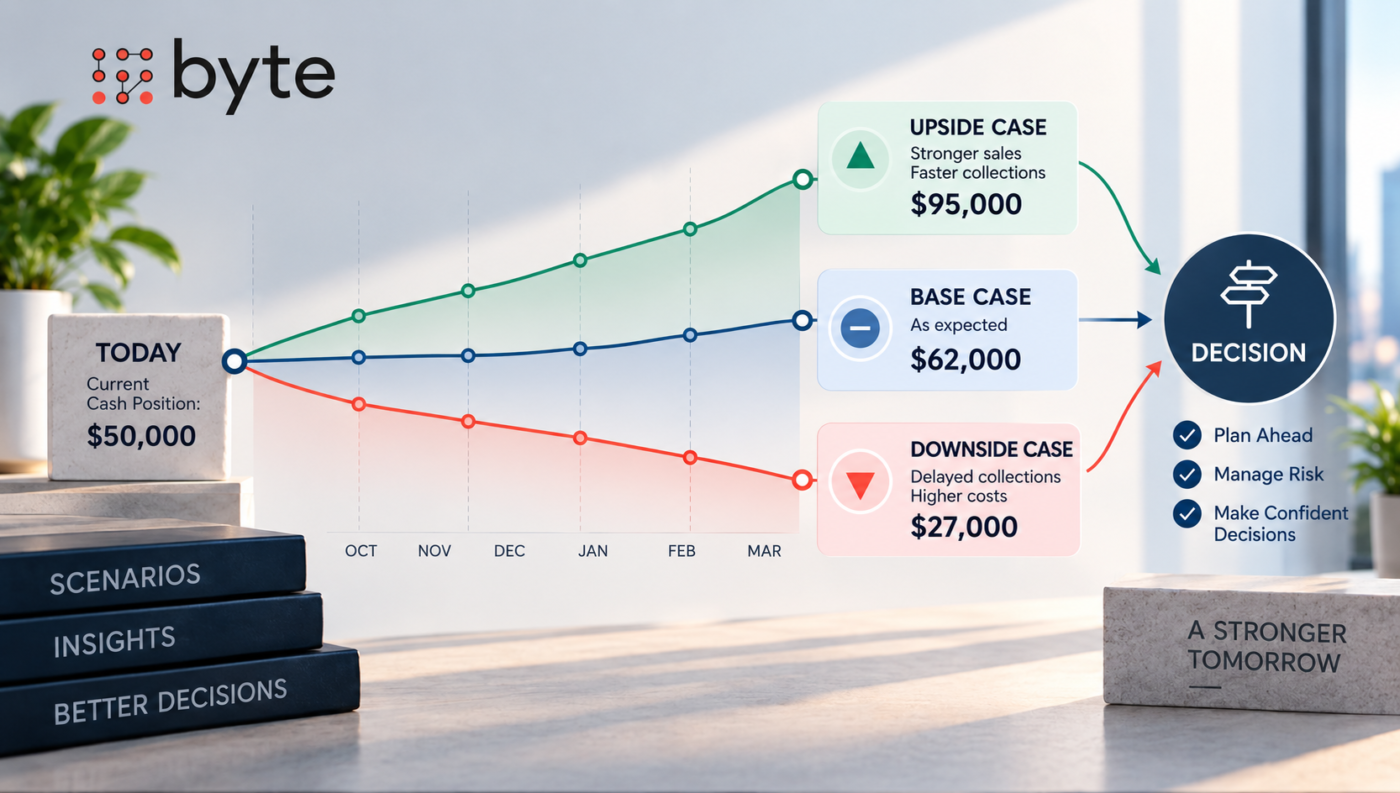
Build at least three scenarios:
Base Case
What do we reasonably expect to happen?
Downside Case
What happens if customers pay later, sales are lower, or an unexpected expense appears?
Upside Case
What happens if sales or collections are stronger than expected?
For example:
Base case → $42,000 ending cash
Downside case → $27,000
Upside case → $55,000
The goal is not to predict which number will definitely happen.
It is to understand the range of possible outcomes.
If the downside case creates a cash problem, the business has an opportunity to respond before that problem becomes urgent.
For a broader look at how financial models can support growth and investment decisions, see How Financial Models Help Startups Make Better Product and Growth Decisions.
Watch Your Accounts Receivable
For many businesses, cash flow problems are not caused by a lack of sales.
They are caused by slow collections.
A company can have strong revenue and still experience cash pressure if customers take too long to pay.
Your forecast should therefore connect accounts receivable to expected cash collections.
Ask:
- Which invoices are outstanding?
- When are they expected to be paid?
- Which customers regularly pay late?
- Are large invoices concentrated in a particular month?
- What happens if a major customer delays payment?
Sometimes the solution is not to cut costs.
Improving the timing of collections can have a greater immediate impact on cash.
Turn the Forecast Into Decisions
This is where a cash flow forecast becomes more than a spreadsheet.
A useful forecast should help management make decisions.
Can we hire?
If a new employee increases monthly costs, what happens to cash over the next six or twelve months?
Can we purchase equipment?
Can the business make the purchase without creating a cash constraint?
Can we take on a large project?
A major contract may generate revenue while also requiring significant spending before the customer pays.
Do we need financing?
If a projected cash shortfall appears several months ahead, the business has more options than if it discovers the problem after cash has already become tight.
Should we accelerate collections?
If accounts receivable is creating pressure, improving collection timing may be more effective than cutting smaller operating expenses.
The key question is:
What decision should we make based on what the forecast is showing us?
This is also why cash flow forecasting should connect with broader financial and business planning. A forecast is most valuable when it helps management evaluate priorities, resources, and trade-offs before committing cash.
For more on connecting financial planning with broader business decisions, see Business Plans Are Not Just for Investors: How They Support Better Business Decisions.
A Useful Forecast Does Not Need to Be Complicated
Small businesses sometimes avoid cash flow forecasting because they assume it requires a complex financial model.
It doesn’t.
A practical starting point can be as simple as:
Opening Cash + Expected Inflows − Expected Outflows = Expected Ending Cash
From there, add the details that matter to your business, such as customer payment timing, payroll, taxes, debt payments, and planned purchases.
The goal is not to build the most complicated spreadsheet.
It is to see potential cash constraints early enough to make better decisions.
Keep the Forecast Updated
A cash flow forecast should not be created once and forgotten.
Actual results will differ from assumptions.
Customers may pay earlier or later. Sales may change. Expenses may increase. A planned purchase may be delayed.
Update the forecast regularly and compare:
Forecast → Actual → Difference → Why?
This creates a useful feedback loop.
If collections are consistently lower than forecast, investigate why.
If payroll is regularly higher than expected, adjust the assumptions.
If certain customers repeatedly pay late, reflect that behavior in future forecasts.
Over time, the forecast can become more useful because the business is learning from its own results.
Five Questions Your Forecast Should Answer
If your cash flow forecast cannot help answering these questions, it may need refinement.
1. How much cash will we have next month?
You should know your expected ending cash position before the month begins.
2. When could cash become tight?
Look several months ahead rather than waiting until the bank balance becomes uncomfortable.
3. Which customers are driving our collections?
Understanding who owes you money and when they are likely to pay is essential.
4. What happens if something goes wrong?
Test delayed collections, lower sales, or unexpected expenses.
5. What decision should we make now?
The forecast should lead to action.
That could mean accelerating collections, delaying a purchase, adjusting hiring plans, building a cash reserve, or exploring financing options.
Final Thoughts
A cash flow forecast is not about knowing exactly what will happen.
It is about knowing what could happen and when.
Start with your actual cash position. Separate expected inflows from outflows. Forecast when money will actually move. Use realistic assumptions and test different scenarios.
Then use what you see to make decisions before a cash constraint becomes a problem.
Most importantly, keep the forecast updated as the business changes.
A useful cash flow forecast gives a business something valuable: time to respond.
Byte Advisory helps businesses strengthen financial planning, improve visibility into cash flow, and turn financial information into better business decisions.
If you are making growth, hiring, spending, or investment decisions without a clear view of future cash, a practical cash flow forecast can give you a better basis for the next decision.
[email protected]
byteadvisory.com/contact/