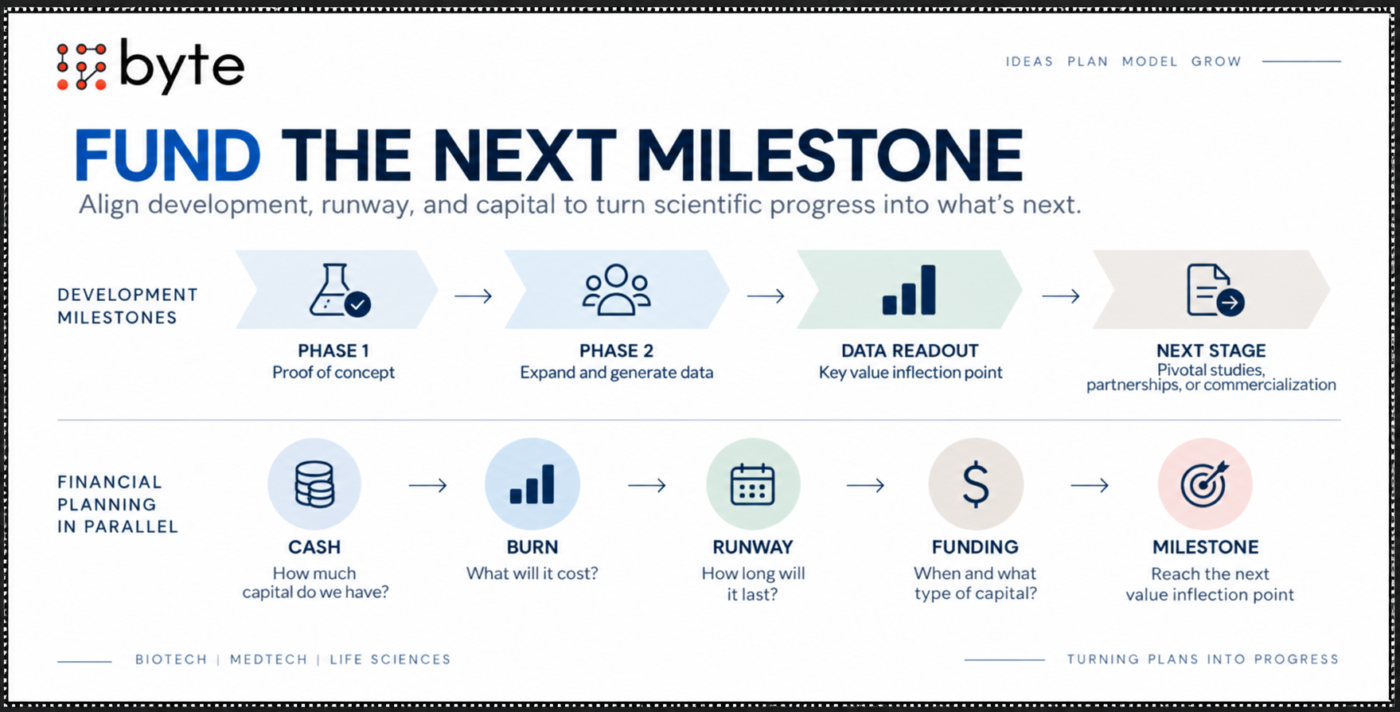
For a biotech company, having cash in the bank is not the same as being funded through the next meaningful milestone.
Consider Solene Oncology, the hypothetical company introduced in our earlier discussion of a stronger-than-expected Phase 1 result.
That result is now behind it, and the next major milestone is a Phase 2 readout roughly 18 months away.
Solene has $12 million in the bank.
That sounds substantial. But enrollment is expected to accelerate, manufacturing costs are rising, and additional regulatory work triggered by the Phase 1 result was not included in the original budget.
The real question is not how much cash Solene has.
It is whether that cash can get the company to the Phase 2 readout without forcing a financing decision at the wrong time.
That is the foundation of a biotech funding strategy: work backward from the next milestone, not forward from a fundraising target.
The goal is not to predict every expense perfectly.
It is to have enough financial visibility to make funding decisions before they become urgent.
Start With the Next Meaningful Milestone
The first funding question is not simply, “How much should we raise?”
It is: what are we trying to accomplish with the capital?
For a biotech company, that destination could be a completed preclinical program, an IND submission, a Phase 1 or Phase 2 readout, pivotal-study readiness, or manufacturing readiness.
Each milestone carries a different cost and timeline.
For Solene, the milestone is clear: reach the Phase 2 data readout.
Everything else, including patient recruitment, laboratory testing, manufacturing, regulatory activity, personnel, and ordinary operating costs, needs to be planned against that destination rather than against a generic annual budget.
Translate the Milestone Into Cash Requirements, Then Check It Against Runway
A development milestone has a financial footprint, and those costs do not arrive evenly.
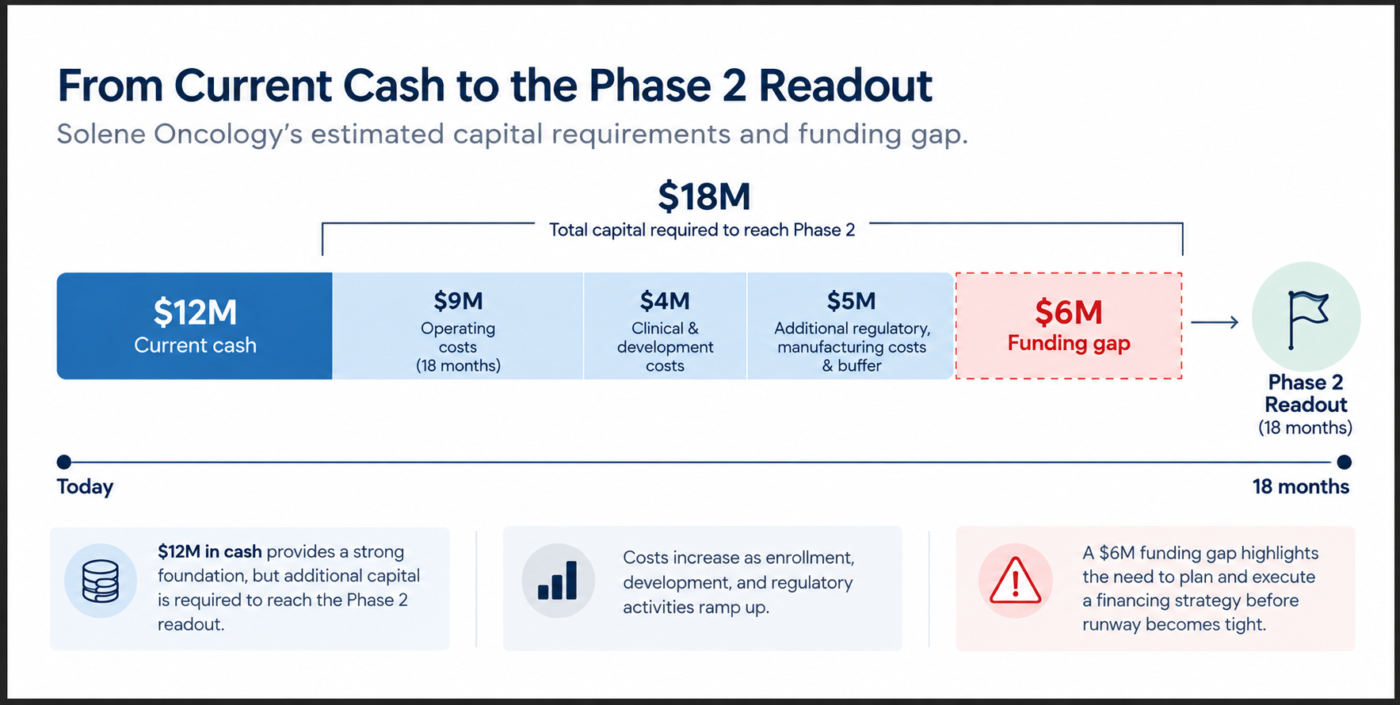
For Solene, the financial model looks like this:
| Funding Requirement | Estimated Amount |
|---|---|
| Current cash | $12 million |
| Operating costs over 18 months | $9 million |
| Clinical & development costs | $4 million |
| Additional regulatory, manufacturing costs & buffer | $5 million |
| Estimated capital required to reach Phase 2 | $18 million |
The important point is not the exact numbers.
It is how the model connects development activity to cash requirements.
Against $12 million in hand, Solene has an apparent $6 million funding gap.
But that does not automatically mean the company should raise exactly $6 million.
The assumptions behind that figure still need to be tested, starting with the runway question underneath it.
A simple runway calculation, such as cash divided by burn, tells management how long the company can keep operating.
It does not tell them whether that runway reaches the milestone that matters.
A company can have enough cash to operate for 20 months and still have a funding problem if its next meaningful milestone is 22 months away.
For Solene, the relevant question is not whether $12 million covers some number of months.
It is whether the runway reaches the Phase 2 readout with an appropriate buffer, given that enrollment can slip, manufacturing requirements can change, and regulatory work can expand.
Stress-Test the Plan: Three Cases, Not One Forecast
A funding model built around one forecast can create false confidence.
Solene should test at least three scenarios.
Base Case
The Phase 2 program progresses approximately as planned; enrollment, spending, and timing stay close to expectations.
Downside Case
Enrollment takes longer, costs increase, or a development activity is delayed. The milestone moves out, extending the period during which Solene continues to spend cash.
Upside Case
The program produces stronger-than-expected evidence, and management decides to accelerate development, expand testing, or invest further in manufacturing.
That upside case is easy to overlook.
But positive results can create a larger funding requirement, not a smaller one.
If Solene’s Phase 2 data shows a particularly strong response in a defined patient population, expanding development around that group could mean more patients, more sites, more manufacturing, and additional regulatory work.
The purpose of scenario planning is not to predict which case will occur.
It is to understand how much financial flexibility the company needs if the development plan changes.
Timing the Raise and Choosing the Right Capital
There is no universal point at which every biotech should raise capital.
Timing depends on the development schedule, milestone visibility, expected cash requirements, and market conditions.
The useful question is:
When can the company raise enough to fund the next stage without letting runway become unnecessarily tight?
The answer also depends on the type of capital available.
Equity financing
Equity financing offers flexibility but dilutes existing ownership and often depends heavily on the company’s latest scientific and financial position.
Non-dilutive funding
Grants and contracts can reduce dilution but may be tied to specific activities, milestones, or eligibility requirements.
Venture debt
Venture debt can extend runway without immediate dilution, but repayment obligations, covenants, and minimum-cash requirements need careful consideration against an uncertain development timeline.
Strategic or milestone-based capital
Partnerships, licensing, and royalty structures can bring substantial capital or validation, but may involve economic terms or development commitments that extend beyond the immediate financing.
The right mix is company- and deal-specific.
But understanding the available options early helps management and the board evaluate financing against the development timeline rather than as a standalone transaction.
Fund the Milestone, Not Just the Company
A financing story becomes clearer when capital is tied to a specific outcome.
Compare:
“We are raising $20 million to continue development.”
With:
“This financing is intended to fund the program through the Phase 2 readout, including the development activities and operating runway required to reach it.”
The second version gives investors a clearer picture of what has already been achieved, what the money is for, how long it is expected to last, and what could affect the timeline.
That turns the financing into part of the development story rather than a separate exercise.
Keep the Financial Plan Connected to the Science
A change in the science can change the financial plan.
A regulatory interaction can shift the timeline. A manufacturing issue can raise the cost. A strong result can expand the opportunity.
None of that changes the company’s current cash balance.
It changes what that cash needs to fund next.
For Solene, that means if Phase 2 data supports a larger opportunity in a defined patient population, expanding around it could require additional clinical sites, testing, manufacturing, regulatory work, or personnel.
The scientific result has not touched the cash already in the bank.
It has changed the requirements of the next stage.
For more on connecting financial models to broader growth decisions, see How Financial Models Help Startups Make Better Product and Growth Decisions.
Plan Past the Immediate Milestone
Reaching the next milestone does not necessarily solve the funding question.
In some cases, it creates a larger one.
If Solene reaches Phase 2 with strong results, it may want to begin later-stage development, expand the patient population, prepare for a pivotal study, or explore a partnership.
The capital required for that stage may look very different from what got the company to Phase 2.
Management does not need to predict years precisely.
But the next funding requirement should not arrive as a surprise immediately after a successful milestone.
Revisit the Strategy When the Plan Changes
A funding strategy is not finished once a round closes.
It should be reviewed when important assumptions change, including:
- Cash
- Burn
- Milestone timing
- Scenario ranges
- Financing alternatives
This is also why funding strategy belongs within the broader business plan rather than as a standalone financial exercise.
See Business Plans Are Not Just for Investors: How They Support Better Business Decisions.
A Biotech Funding Strategy Checklist
Before beginning the next financing process, management should be able to answer:
- What is the next meaningful development milestone?
- What work is required to reach it, and what will that cost?
- Does current runway extend through the milestone with an appropriate buffer?
- What happens if the milestone is delayed?
- What happens if costs increase?
- What happens if evidence is stronger than expected?
- What type of capital best fits this stage?
- What should the financing specifically enable?
- What will the company likely need to fund after the milestone?
If these questions cannot be answered clearly, the funding strategy needs more work before the fundraising process begins.
Fund the Next Milestone With Room to Adapt
Biotech funding strategy is not simply about raising enough money to keep the company operating.
It is about connecting capital to progress.
Start with the next meaningful milestone, translate it into cash requirements, test the assumptions against downside and upside scenarios, and determine when financing needs to begin and which type of capital fits the stage.
For Solene, the important question was never simply whether it had $12 million.
It was whether that $12 million could fund the company to the next meaningful milestone, with enough room to respond if the plan changed.
That is what turns a fundraising target into a funding strategy.
Byte Advisory works with biotech and medtech companies on financial planning, strategic planning, commercialization, and investor-facing materials.
byteadvisory.com/contact
[email protected]