
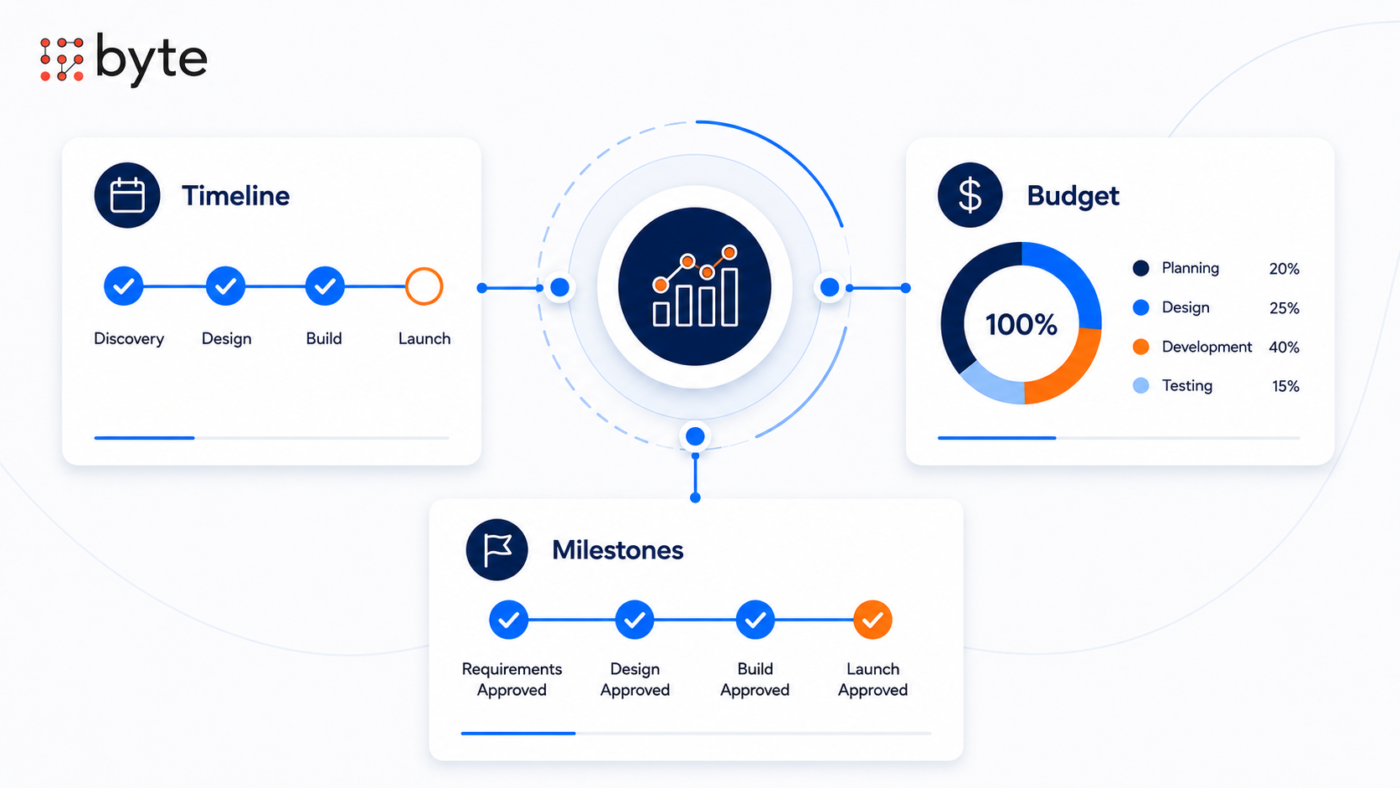
Software project planning becomes unreliable when the timeline, budget, and milestones tell different stories.
A deadline may look realistic until the team compares it with the work still required. A budget may appear controlled even when no one can explain what has actually been completed. And a milestone means very little when it is only a date on the calendar.
Timelines, budgets, and milestones need to move together. When the scope changes, the cost or delivery date may also need to change. When a milestone slips, leadership should understand what that means for the remaining work.
Clear planning will not remove every technical risk. It will make problems easier to see while there is still time to respond.
1. Build the Timeline Around the Work
Many software projects begin with a preferred launch date.
The date may be tied to an investor meeting, marketing campaign, customer commitment, or industry event. Those deadlines may be important, but they do not determine how long the technical work will take.
A realistic timeline needs to account for the full delivery process, including:
- Requirements and design
- Development
- Client reviews
- Integrations
- Testing and corrections
- Deployment
- Training or launch support
Some activities can happen at the same time. Others cannot begin until an earlier decision has been made.
Development may depend on approved user flows. An integration cannot be tested until the team receives working credentials. User acceptance testing cannot begin while the main workflow is still changing.
Leaving those dependencies out of the schedule does not make the project faster. It simply pushes the delay into a later stage, when it is usually more expensive to manage.
The timeline should also show who controls each dependency. The development team may own coding and technical testing, while the client owns approvals, content, access, compliance decisions, or third-party subscriptions.
Write those responsibilities into the plan. When an input is late, both sides should know whether the project pauses, another workstream moves forward, or the delivery date changes.
A useful timeline reflects the work as it is currently understood—not only the date everyone hopes to meet.
2. Connect the Budget to the Scope
A technology project budget is easier to manage when leadership can see what the money is expected to produce.
One total figure may be easy to present, but it does not show how the cost is distributed across discovery, design, development, testing, integrations, and launch.
Breaking the budget into phases makes several questions easier to answer:
- How much has been spent?
- What has been completed?
- Which work remains?
- Are new requests using money reserved for a later phase?
- Does the remaining budget still support the remaining scope?
The pricing model also shapes how the budget should be monitored.
A fixed-price project normally depends on well-defined deliverables and clear exclusions. A time-and-materials engagement offers more flexibility, but the client needs regular visibility into the hours used and the work produced.
Neither model removes financial risk. They simply manage it differently.
The project budget should also identify costs outside the core development fee. Hosting, cloud services, software licenses, APIs, security reviews, payment-processing fees, and ongoing maintenance can all increase the total cost of ownership.
A project may stay within the development estimate and still exceed the client’s expected spending if those items were never included in the discussion.
Uncertain work needs honest treatment as well. An integration that has not been technically reviewed may require a range, a short discovery phase, or a contingency. Presenting it as routine work creates confidence the estimate may not deserve.
A budget built on assumptions can still be useful. Those assumptions simply need to be visible.
3. Make Milestones Represent Real Progress
A date alone is not a milestone.
“Design complete by May 15” sounds clear, but it leaves important questions unanswered. Have the wireframes been approved? Are mobile layouts included? Has the main user journey been reviewed? Can development begin without reopening major decisions?
A meaningful milestone should confirm that the project has reached a reviewable outcome, such as:
- Requirements approved
- Core workflow demonstrated
- Integration tested
- User acceptance completed
- Production release approved
Each milestone needs an owner, a defined result, and a clear approval process.
Take a milestone called “CRM integration complete.” A working connection is not always enough. Both sides may also need to confirm that records transfer correctly, duplicate entries are handled, errors are logged, and the workflow recovers when the CRM is unavailable.
Without those conditions, the development team may consider the milestone complete while the client believes important work is still missing.
Milestones can also serve as financial control points.
In a milestone-based engagement, payment may follow an approved deliverable. In a time-and-materials project, the milestone review gives leadership a chance to compare the progress made with the budget already used.
The purpose is not to create more paperwork. It is to make sure the project is producing something clear, usable, and reviewable as money is being spent.
4. Update the Plan When the Work Changes
Most software projects change during delivery.
A client may identify a missing workflow. Testing may reveal that a feature needs to be simplified. A third-party platform may behave differently than expected. Leadership may decide that a new report or approval step has become essential.
The request may be reasonable. It still needs to be measured against the current plan.
Consider a reporting feature added halfway through development. On the surface, it may look like one additional screen. In practice, the work could require new data fields, permission rules, filters, exports, design changes, and testing.
Once the request is approved, the timeline, budget, and affected milestone should be updated together. Otherwise, the project may still be described as “on track” even though the original plan no longer reflects the work.
Every meaningful change should answer three questions:
- What additional work is required?
- How will it affect timing and cost?
- What needs to move, change, or be removed?
Sometimes the client will approve a higher cost or a later delivery date. In other cases, another feature may be delayed to protect the first release.
The trade-off needs to be visible.
A change-request process should not block useful ideas. It should stop those ideas from becoming unplanned commitments.
5. Reforecast Before the Project Loses Control
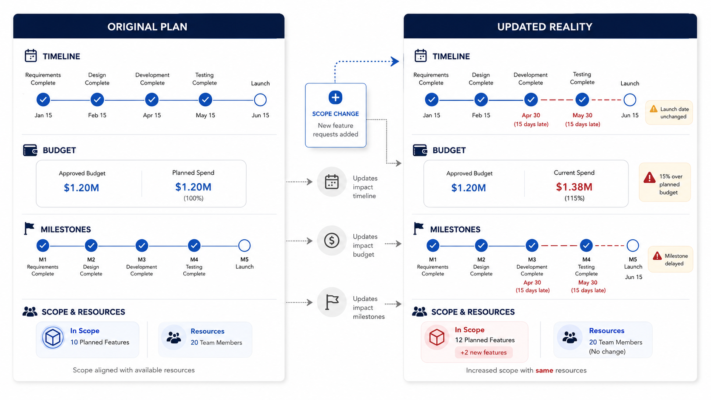
The original project plan will not remain perfectly accurate forever.
As development progresses, the team learns more. Some work finishes faster than expected. Other areas reveal more complexity. Integrations create delays, priorities change, and testing uncovers issues that need attention.
Continuing to report against an outdated plan only delays the decision.
A project review should compare the current position with the original assumptions. Leadership needs to understand:
- Work completed
- Budget used
- Work remaining
- Delayed dependencies
- Approved changes
- Current risks
- Revised delivery date
- Expected final cost
This does not need to become a complicated financial exercise. The purpose is to show where the project actually stands.
Suppose a project has used 70% of its budget but completed only half of the agreed work. That does not automatically mean the project has failed. Early phases may have required more effort, or the remaining work may be simpler.
It does mean someone should review the difference before committing the remaining budget.
Reforecasting does not mean the original plan failed. It means the team now knows more than it did at the start.
The greater risk is waiting until the budget is nearly exhausted or the launch date has already passed before admitting that the plan changed.
Keep the Three Controls Connected
Timelines, budgets, and milestones should tell the same story.
The timeline shows when the work is expected to happen. The budget shows what resources are available. Milestones confirm whether the project has produced something meaningful and reviewable.
When the scope changes, all three need another look.
Leadership should know whether the remaining budget supports the remaining work, whether current milestones still reflect the agreed scope, and whether the delivery date remains realistic.
Software project planning cannot remove uncertainty. It can make that uncertainty visible early enough to manage.
Byte Advisory helps businesses connect product scope with realistic timelines, budgets, milestones, and delivery plans through its custom software development services.
Planning a software project? Speak with Byte Advisory about creating a plan your development team can work from and leadership can monitor.
[email protected]
byteadvisory.com/contact/