
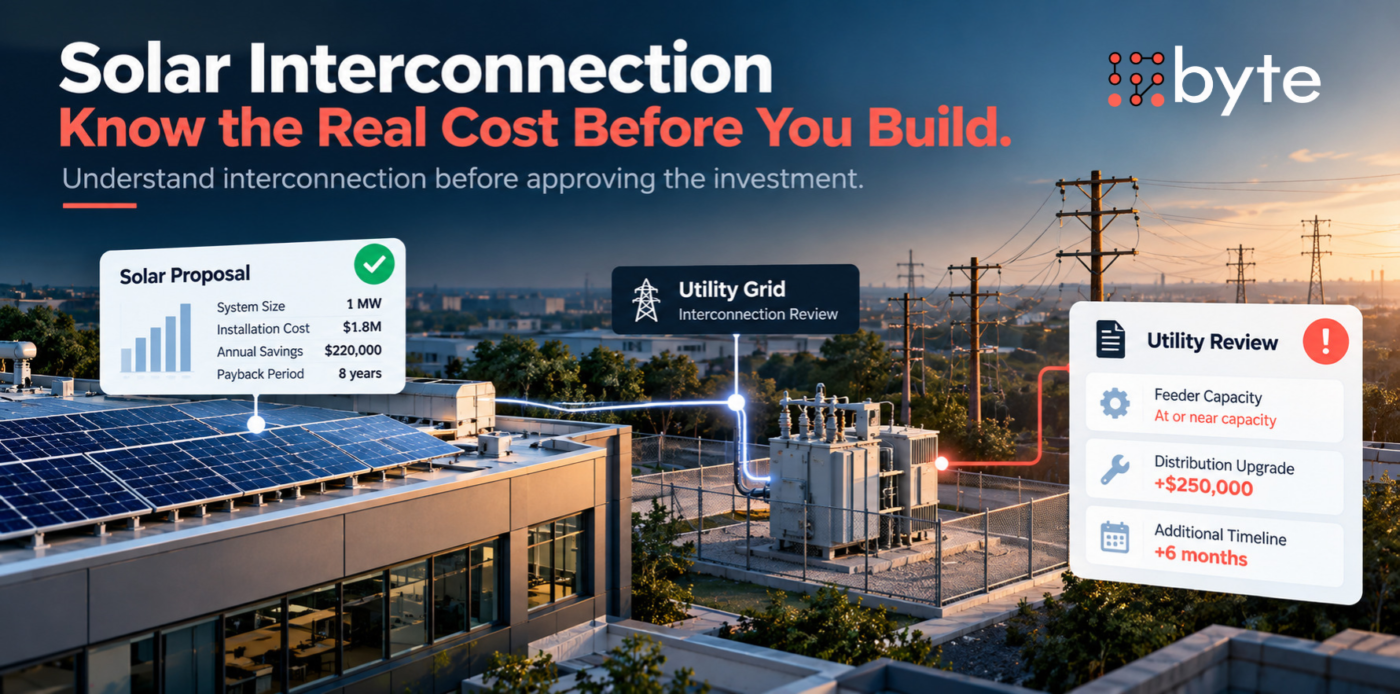
A solar proposal can look financially attractive before the utility has even confirmed how the system will connect to the grid.
Take Ridgeline Manufacturing, a hypothetical commercial project evaluating a 1 MW rooftop system. The initial numbers look good: roughly $1.8 million to install, about $220,000 a year in expected energy savings, and an eight-year payback.
Then the utility’s interconnection review comes back.
The feeder serving Ridgeline’s building is already carrying significant load nearby, and the utility requires a distribution upgrade before the system can connect at full capacity. That adds $250,000 to the project and six months to the timeline.
The panels haven’t gotten more expensive. The cost of getting the project connected has changed, and the payback math now needs to be redone.
That’s why interconnection belongs in project planning, not at the end as paperwork.
What Interconnection Actually Involves
Interconnection is the process by which a utility evaluates a proposed solar system and determines whether, and how, it can safely connect to the electric grid.
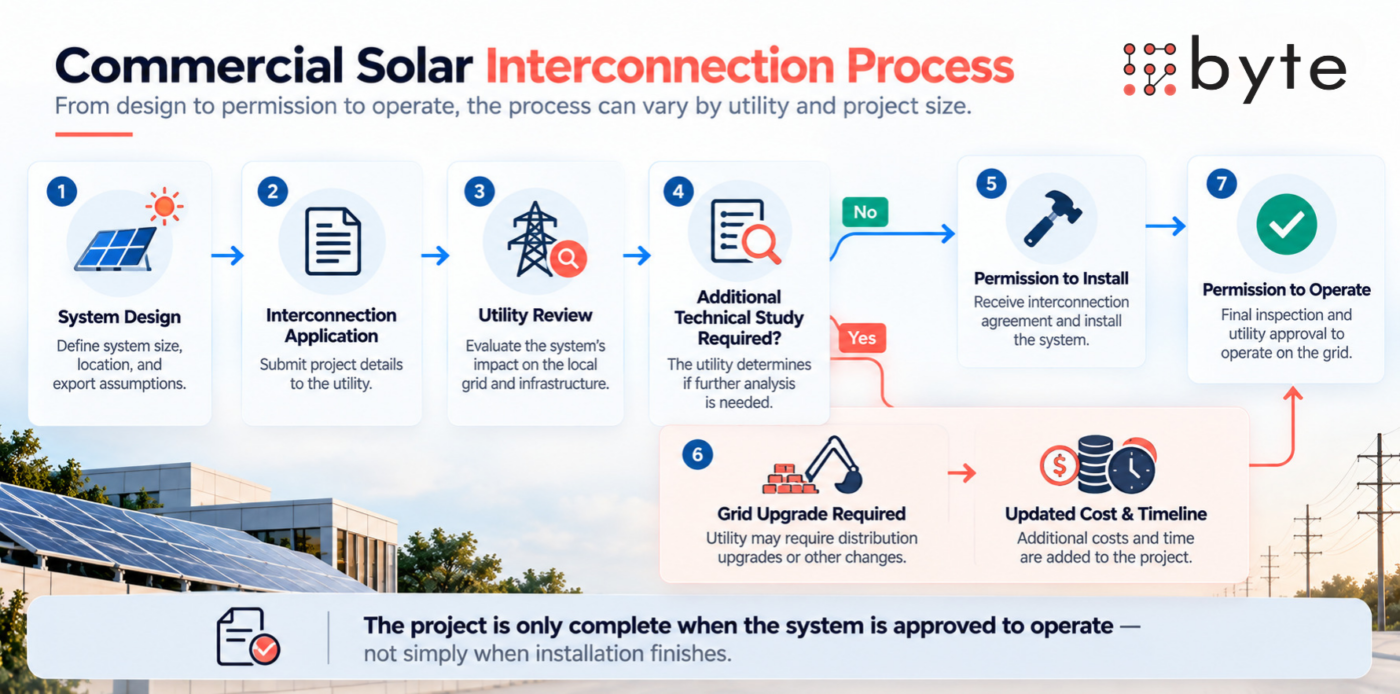
A commercial project may move through system design, an interconnection application, utility review, technical studies where required, an interconnection agreement, installation and inspection, and finally permission to operate.
The exact process varies by utility and jurisdiction. Smaller or less complex projects may qualify for expedited screening, while projects that do not pass initial review can require additional technical studies to determine whether grid upgrades are needed. Federal interconnection procedures provide standardized frameworks for certain projects, while state and utility requirements determine how those frameworks are applied locally.
This distinction matters because an interconnection review is not simply an approval step. It can identify technical requirements, additional costs, and timing issues that were not visible in the original solar proposal.
It is also separate from local permitting. Building and electrical permits are different approval tracks from utility interconnection. A system can be permitted for construction and still not have permission to operate on the utility grid.
What the Utility Is Actually Evaluating
The specifics vary by utility, but reviewers are generally looking at factors such as:
- The system’s size relative to the local distribution network
- Existing electrical infrastructure, including service and transformer capacity
- Where the system will connect
- How much electricity will be consumed on-site versus exported
- Protection and control requirements
- Potential effects on the local grid
For Ridgeline, the key issue was feeder capacity.
A system designed primarily for on-site consumption with limited exports can present a different interconnection profile from one designed to send significant amounts of power back to the grid.
The utility assessment is ultimately about whether the proposed system can operate safely and reliably within the existing electrical infrastructure. DOE identifies interconnection as a key challenge as the number of distributed energy projects grows, with project requirements and processes varying across jurisdictions.
How This Changes the Business Case
A business evaluating solar based only on installation cost, energy savings, and payback alone is missing part of the equation.
The fuller picture can include:
Interconnection costs + required upgrades + additional engineering + financing costs + project timing
For Ridgeline, the $250,000 upgrade and six-month delay do not necessarily kill the project’s economics. They change them.
The total installed cost rises from roughly $1.8 million to $2.05 million, while the first year of expected savings arrives later than originally planned.
That pushes simple payback out and changes near-term cash flow.
That is not necessarily a reason to walk away from the project. It is a reason to make the investment decision using the actual post-review numbers rather than the original proposal.
For more on using financial models to test investment and growth decisions, see How Financial Models Help Startups Make Better Product and Growth Decisions.
Interconnection Is Only One Approval Among Several
Depending on the project and jurisdiction, a business may also need building permits, electrical permits, structural review, fire or safety sign-off, equipment approvals, and final permission to operate.
These may involve different parties and different timelines.
The useful management question isn’t simply:
“Has the solar project been approved?”
It is:
“Which approvals are still outstanding, who owns them, and how could each affect the commercial operation date?”
Keeping those responsibilities visible helps prevent an approval that appears minor from becoming a project delay.
Questions to Ask Before Signing a Solar Proposal
Before committing to a commercial solar project, management should be able to answer:
- Who is the utility serving the property, and what are its interconnection requirements?
- Has an interconnection application been submitted?
- What system size and export assumptions does the application use?
- Is the project likely to require additional technical review?
- Could grid upgrades be required?
- Who is responsible for those costs?
- What timeline has been assumed for approval?
- What happens financially if approval takes longer?
- Does the project’s ROI still hold under a higher-cost scenario?
- Could the approved system differ from the original proposal?
These questions do not replace engineering, legal, or utility guidance.
They surface where assumptions still exist before those assumptions become project costs.
Build Interconnection Into the Financial Model
The financial model should reflect the project as it is actually likely to be delivered.
That means considering:
- System cost
- Interconnection costs
- Required upgrades
- Financing
- Operating assumptions
- Expected energy savings
- Commercial operation date
Then test the project under at least three cases.
Base case: Interconnection proceeds as expected.
Higher-cost case: Required upgrades increase the project cost, as they did in Ridgeline’s example.
Delayed case: Commercial operation begins later than planned.
The point isn’t to assume the worst.
It is to know whether the investment still holds up once reasonable uncertainty is priced in.
This same principle applies to broader business planning: strategic investments are stronger when the assumptions behind them are visible, connected, and testable. For more on connecting strategic decisions with financial planning, see Business Plans Are Not Just for Investors: How They Support Better Business Decisions.
Understand the Connection Before You Sign
Solar can be a strong investment for a business, but the project doesn’t end with panels, production estimates, or a payback calculation.
The system has to actually connect.
For Ridgeline, understanding interconnection early was the difference between a $250,000 surprise mid-project and a $250,000 cost accounted for in the investment decision from the beginning.
That is the value of addressing interconnection early.
The goal isn’t simply to get solar installed. It is to make sure the project still works when the real costs, utility requirements, timeline, and expected financial return are on the table.
Byte Advisory helps businesses evaluate strategic investments through financial planning, business planning, and related advisory support.
Considering solar for your business? Speak with Byte Advisory about evaluating the project beyond the panels, including the financial assumptions, timeline, and decisions that support the investment.