Many products do not fail because the code was bad. They fail because the wrong thing was built too early.
A founder may have a strong idea, a feature list, a rough design, and urgency to move. A business owner may know the process they want to digitize or the platform they want to create. The natural next step can feel obvious: hire developers and start coding.
But if the product direction is unclear, early coding can quickly become expensive.
The strongest digital products are not built by rushing into development. They are built by making the right product decisions before development begins.
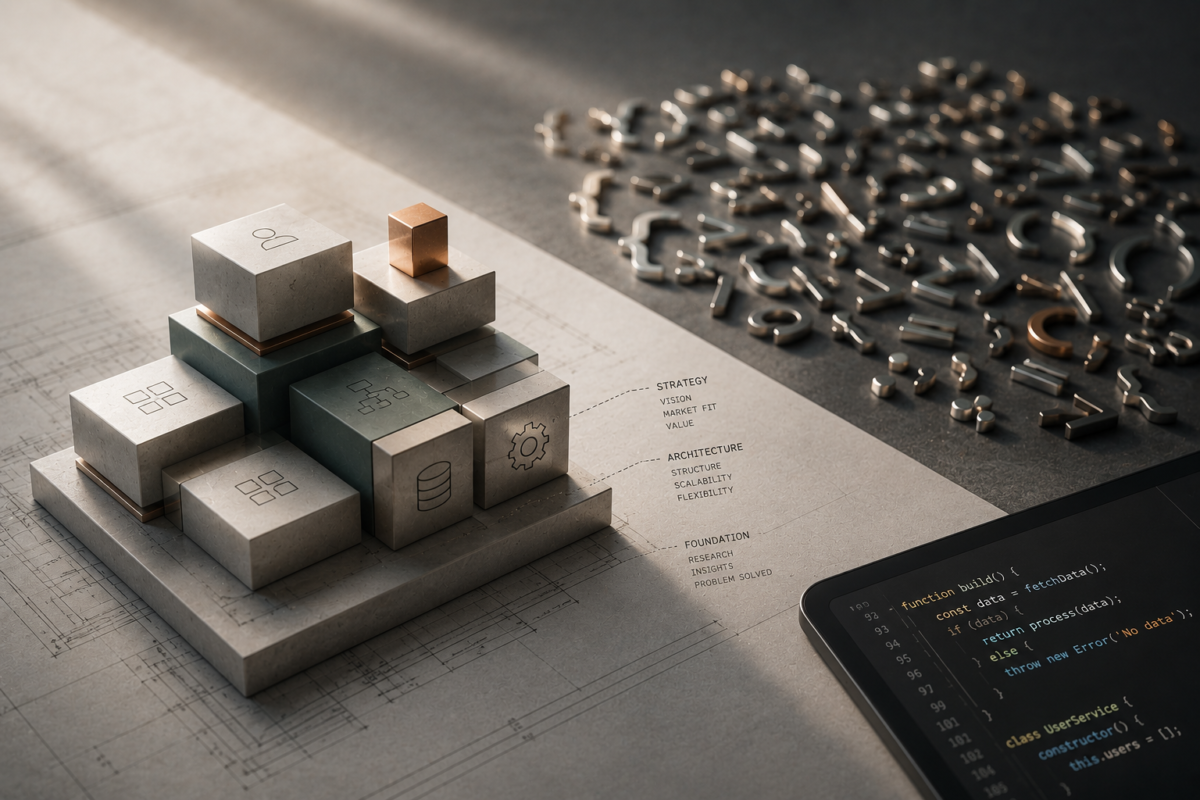
Early product strategy helps define what should be built, why it should be built, who it should serve, and what the first version needs to prove. It gives the technical team a clearer path and gives the business a better chance of turning an idea into a focused, usable, and commercially relevant product.
For startups and growing companies, this matters because time, budget, and attention are limited. Every feature built without clear purpose can create delay, rework, and unnecessary cost.
Starting Development Too Early Can Create Expensive Mistakes
Coding is essential. Without development, the product will not exist. But coding should not begin before the business has answered the most important product questions.
When teams rush into development, they often build around assumptions. They assume they understand the user. They assume the first feature list is correct. They assume the workflow is simple. They assume technical decisions can be adjusted later.
Sometimes those assumptions are right. Often, they are not.
The team may later realize the product is solving too broad of a problem. A key user workflow may be missing. A feature that seemed important may not matter to early users. Integrations may be more complex than expected. Admin tools, reporting, permissions, or operational logic may have been overlooked.
By that point, the cost of change is higher.
Changing direction during strategy is normal. Changing direction after weeks or months of development is expensive.
This is why early product strategy is not a delay. It is a way to reduce waste before it happens.
Product Strategy Turns an Idea Into a Buildable Plan
A product idea is not the same as a product plan.
An idea may describe what the founder wants to create. A product plan explains how the first version should work, who it is for, what problem it solves, and what needs to happen before development starts.
Product strategy does not need to become a long theoretical document. It should create enough clarity for the business, product, and technical teams to move in the same direction.
A strong early product strategy answers questions such as:
Who is the product for?
What problem does it solve?
What is painful about the current process?
What does the user need to accomplish first?
Which features are essential for the first version?
Which features can wait?
What does the MVP need to prove?
How will success be measured after launch?
What business process will the product support?
What technical or operational risks need to be considered early?
These questions help separate a promising idea from a practical build plan.
For example, a founder may want to build a marketplace, SaaS platform, mobile app, CRM tool, or automation system. Each can be built many different ways. The right version depends on the user, workflow, business model, operational needs, and launch goals.
Without strategy, a development team may build what was requested, but not necessarily what the business needs.
The MVP Should Be Focused, Not Overbuilt
One of the most common early product mistakes is trying to build too much in the first version.
Founders often want the product to feel complete from day one. They may want dashboards, multiple user roles, payment flows, admin panels, automations, notifications, integrations, mobile access, reporting, AI features, and custom workflows included in the initial build.
Some of those features may be useful later. But not all of them are needed to test the core idea.
A strong MVP is not the smallest possible product. It is the most focused version of the product that can prove whether the idea works.
The first version should be built around the core user journey. It should help a real user complete the main action the product is designed to support. It should be simple enough to launch, but strong enough to generate useful feedback.
When the MVP is too broad, development takes longer, costs increase, and the business delays learning from real users.
Early product strategy protects the MVP from unnecessary complexity. It helps the team decide what belongs in version one and what should move to a later phase.
That decision alone can save significant time and budget.
Rework Is Often a Strategy Problem, Not a Coding Problem
Rework is one of the biggest hidden costs in product development.
It does not always happen because the developers made mistakes. It often happens because the product direction was not clear enough when development began.
Rework can appear in many forms:
Features need to be rebuilt because the workflow was unclear.
Screens need to be redesigned because user roles were not defined.
Data structures need to change because reporting needs were ignored.
Integrations become harder because technical requirements were not planned.
Admin tools are added late because internal operations were not considered.
The product becomes bloated because every idea was treated as a priority.
This is why product strategy and technical planning should work together.
Good product strategy does not replace development. It makes development more efficient. It gives designers and developers clearer decisions to work from. It also gives the business a better way to evaluate tradeoffs.
A technical team can build faster when the product scope is clear. A founder can make better decisions when the roadmap is connected to business goals. A project manager can control timelines more effectively when priorities are defined before the build begins.
The earlier these decisions are made, the less likely the project is to drift.
Product Decisions Are Business Decisions First
Technology is only one part of building a product.
A successful product also depends on business decisions. These decisions shape what gets built, how it gets used, and whether it can grow.
Before coding begins, leadership should understand the product’s purpose. Is it meant to generate revenue directly? Improve internal efficiency? Support an existing service? Help a team manage work better? Reduce manual work? Create a better customer experience?
Each goal leads to different product decisions.
A revenue-generating SaaS product may need pricing logic, onboarding, billing, analytics, and retention planning. An internal operations tool may need workflow clarity, role permissions, reporting, and integrations with existing systems. A marketplace may need supply-and-demand logic, trust features, transaction flows, and admin oversight. A mobile app may need careful prioritization around user behavior and repeat use.
These are business questions before they are technical questions.
When product strategy is done well, the technology supports the business model instead of forcing the business to adapt around unclear development choices.
What Founders Should Clarify Before Hiring Developers
Before hiring developers or starting the first sprint, founders should clarify a few essential areas.
The first is the user. A product should not be built for a vague audience. The team should understand who the initial users are, what they struggle with, and what they need to accomplish.
The second is the core workflow. What is the main process the product supports? What happens first, second, and third? Where does the user get value? Where could friction appear?
The third is the MVP scope. Not every feature belongs in version one. Founders should define must-have features, nice-to-have features, and features that can wait until after user feedback.
The fourth is the business model. Even if pricing is not finalized, the team should understand how the product may create value. Will customers pay directly? Will the product support a service? Will it reduce costs? Will it improve speed, accuracy, or visibility?
The fifth is operational reality. Who will manage the product after launch? What admin tools are needed? What data needs to be tracked? What support process will be required?
The sixth is technical risk. Some features may look simple from the outside but require careful planning. Integrations, data security, AI automation, user permissions, payments, compliance, and scalability should be discussed early.
These questions do not slow the project down. They make the build more disciplined.
Early Strategy Helps Protect the Budget
Most early-stage product budgets are limited. Even when a company has funding, capital still needs to be used carefully.
Without strategy, budget often gets spent on features that do not prove the core business case. Teams may build too many screens, too many workflows, too many custom options, or too many integrations before they know what users actually need.
This can make the product more expensive without making it more valuable.
Early product strategy helps leadership decide where the first dollars should go. It identifies the smallest meaningful release, reduces avoidable changes, and creates a clearer path from launch to future improvements.
The goal is not to underbuild. The goal is to build with purpose.
A disciplined product strategy helps answer:
What needs to be built now?
What can be tested manually first?
What can be phased later?
What should be automated only after validation?
What is required for launch?
What is required for scale?
This type of planning helps the business avoid spending too much too early.
Advisory-Led Development Creates a Better Starting Point

Product strategy should not happen separately from development.
The best approach brings business thinking and technical thinking together early. Strategy helps define what matters. Technical planning helps determine how it can be built properly.
This matters because not every product decision has the same technical impact. A small feature request can sometimes require major backend work. A simple user experience may require careful data architecture. An automation idea may depend on third-party systems, APIs, or process quality. A reporting feature may require the right data structure from the beginning.
When strategy and development work together, the team can make better tradeoffs.
They can decide what to simplify, what to phase, what to build now, and what to design for later. They can also identify risks before those risks become expensive problems.
A purely technical execution team may wait for instructions and build what is requested. An advisory-led technology partner helps shape the product before code is written.
That is where early strategy creates real value.
How Byte Advisory Supports Better Product Decisions
At Byte Advisory, we believe product development should begin with clarity.
That means helping clients think through the business case, product scope, user journey, MVP priorities, technical requirements, and execution plan before development moves too far.
This approach is especially valuable for founders and growing businesses that know they need to build something, but are still refining what the first version should include.
Byte Advisory can support early-stage product planning by helping define:
Product goals
MVP scope
User workflows
Feature priorities
Technical requirements
Build phases
Budget expectations
Development timelines
Automation opportunities
Launch and post-launch considerations
The goal is to help clients move from idea to execution with fewer assumptions and better structure.
This does not mean every detail must be perfect before development begins. Product development always involves learning. But the team should start with enough strategic clarity to reduce avoidable rework and protect the client’s investment.
Final Takeaway
Early coding can feel like progress, but progress without direction can become expensive.
Before building, founders and leadership teams should understand what the product needs to prove, who it needs to serve, and which features truly matter in the first version.
The best products are not created by coding faster. They are created by making better product decisions before coding begins.
Early product strategy helps protect budget, reduce rework, prioritize the right features, and align the build with real business goals.
For companies preparing to build a digital product, the first question should not be, “How quickly can we start coding?”
The better question is, “Are we clear on what we should build, why it matters, and what the first version needs to prove?”
At Byte Advisory, we help businesses answer those questions before development begins, so the product is built with stronger direction, clearer priorities, and a better path from idea to execution.
To discuss your product strategy, MVP scope, technology roadmap, or development planning before coding begins, contact Byte Advisory through our website at byteadvisory.com/contact/ or email us at [email protected].