
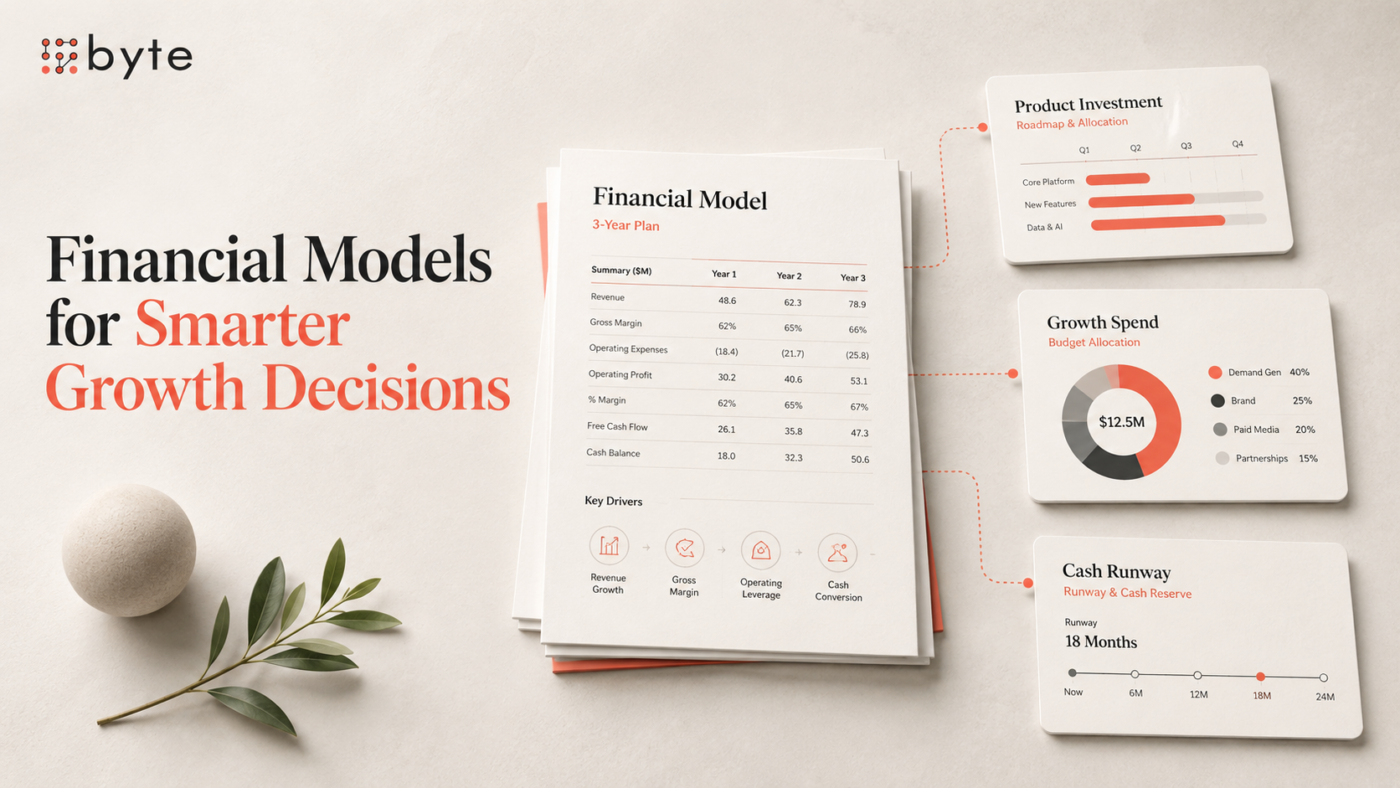
A startup wants to hire two developers, increase marketing spend, and launch a new product feature in the same quarter.
Each investment may make sense on its own. The harder question is whether the business can support all three at the same time.
New hires increase monthly burn before they generate a return. Product development may take longer than expected, while marketing requires spending before the company knows whether customer acquisition will improve. Meanwhile, customers may be paying more slowly than forecast.
A financial model helps founders see how these decisions interact before committing resources.
That is why financial models for startups should do more than support fundraising. A useful model helps founders understand how decisions around product, hiring, marketing, pricing, and growth affect cash, runway, and the resources available to the business.
The goal is not to predict the future perfectly.
It is to understand what needs to be true for a decision to work.
Financial Models Should Support Decisions, Not Just Fundraising
Many founders first build a financial model when preparing to raise capital.
Investors may want to see revenue forecasts, operating expenses, hiring assumptions, margins, and funding requirements. But the model becomes far more useful when management continues using it after the fundraising process.
It can help answer practical questions:
- Can we afford another hire now?
- What happens to runway if revenue grows more slowly?
- How much marketing spend can the business support?
- What happens if a product launch is delayed?
- How would a pricing change affect margins?
- When might additional funding be required?
These are management decisions, and each has a financial consequence.
A growth opportunity can make strategic sense while still creating pressure if the company commits cash before the expected return arrives.
Strong startup financial planning helps founders understand that timing before resources are committed.
Connect Product Investment to Cash and Runway
Product decisions often create costs before they create revenue.
A new feature may require development, design, testing, software, hosting, customer support, and future maintenance. Larger initiatives may also require employees or contractors.
Those costs do not make the project unattractive. They simply need to be visible.
Suppose a startup expects a new feature to improve conversions after launch. The financial plan should not only include the expected additional revenue. Management also needs to understand when development spending begins, how long the build may take, whether new staff are required, and when customers are likely to begin paying for the result.
If a September launch moves to November, the business absorbs two additional months of costs before seeing the expected return.
That delay may affect cash runway, hiring, marketing, or the timing of another initiative.
Product strategy therefore needs to connect with finance. Before committing significant capital, founders should understand both what the product needs to achieve and what the business can reasonably afford to invest.
Model the Gap Between Investment and Return
Growth rarely pays for itself immediately.
A new employee begins receiving a salary before the business realizes the full benefit of that hire. Marketing spend occurs before enough customers arrive to prove the investment worked. Expansion into a new service, product, or market can create the same gap.
A financial model helps management understand the period between committing resources and receiving the expected return.
For example:
- How many additional customers are needed to support a new hire?
- What level of revenue or gross margin would justify the investment?
- How long can the business fund the initiative before it needs to produce results?
Not every investment needs an immediate return. Some decisions are made for long-term strategic reasons.
But founders should still understand how much cash is being committed, how long the investment can be supported, and what assumptions need to hold for the decision to make sense.
Use Scenarios Instead of One Perfect Forecast
No financial model can tell a startup exactly what will happen.
Revenue may arrive later than expected. Costs can increase. A launch may slip. Customer acquisition could outperform expectations. A major contract might close earlier or later than planned.
Relying on one forecast can hide that uncertainty.
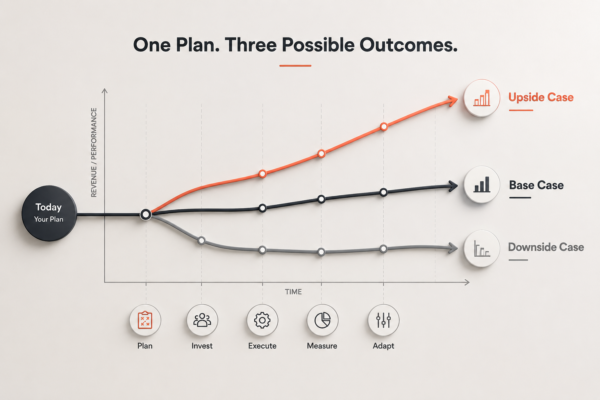
A more useful approach is to test a few practical scenarios.
Base case: What management currently expects based on normal revenue, hiring, spending, and product assumptions.
Upside case: What happens if sales, conversion, or product adoption perform better than expected, and what additional resources stronger growth may require.
Downside case: What changes if revenue slows, costs increase, customers take longer to pay, or a product launch is delayed.
Scenario planning gives management more than a revenue forecast. It provides a view of how decisions may need to change when assumptions do not hold.
Instead of asking only “What do we think will happen?”, management can ask “What would we change if the outcome is different?”
Revenue Is Not the Same as Cash
A startup can increase revenue and still run into cash pressure.
Customers may pay 30, 60, or 90 days after being invoiced, while payroll, software, contractors, marketing, and other operating expenses continue to fall due.
Consider a company that hires ahead of expected demand.
Payroll begins immediately. New customers arrive over the following months. Invoices are then issued, and cash may not be collected until several weeks later.
Revenue may be growing while the bank balance is falling.
A growth plan can look attractive on the P&L and still put pressure on cash.
That is why a useful financial model should provide visibility into more than sales and profitability. Founders also need to understand cash collections, monthly burn, upcoming obligations, and remaining runway.
This becomes especially important when the company is funding several growth initiatives at the same time.
Decide What to Fund Now—and What Should Wait
One of the most valuable outcomes of a financial model is not a revenue projection.
It is a priority decision.
Management may begin with several worthwhile initiatives and discover that funding all of them at once would put unnecessary pressure on cash.
That does not mean the ideas are bad.
The timing may simply need to change.
The model might show that the company should:
- Hire one developer now instead of three
- Delay a non-core product feature
- Increase marketing spend after conversion improves
- Launch one service before investing in another
- Strengthen cash collections before expanding
- Raise additional capital before the next major growth phase
Finance becomes useful when it helps a company decide not only whether it can afford an initiative, but when it should happen and what should receive funding first.
For a broader look at connecting business planning, product requirements, budgets, and execution, see From Idea to Execution: What Startups Need Before They Start Building.
Financial Models Are Management Tools
A good financial model does not tell a founder exactly what will happen.
It shows what needs to be true for a decision to work.
Product investment can be tested against available cash. Hiring can be connected to expected revenue. Marketing spend can be evaluated against customer acquisition assumptions. Growth plans can be compared with runway and funding needs.
When assumptions change, management can see the financial effect early enough to respond.
The purpose is not to eliminate risk. Growing businesses will always make decisions with incomplete information.
The purpose is to understand the financial consequences before committing cash, people, and time.
Through its financial consulting services, Byte Advisory helps startups connect financial models, forecasts, cash requirements, and growth plans so management can make better-informed resource decisions.
Planning a product investment or your next stage of growth? Speak with Byte Advisory about building a financial model that helps you test the financial impact before committing resources.
byteadvisory.com/contact/