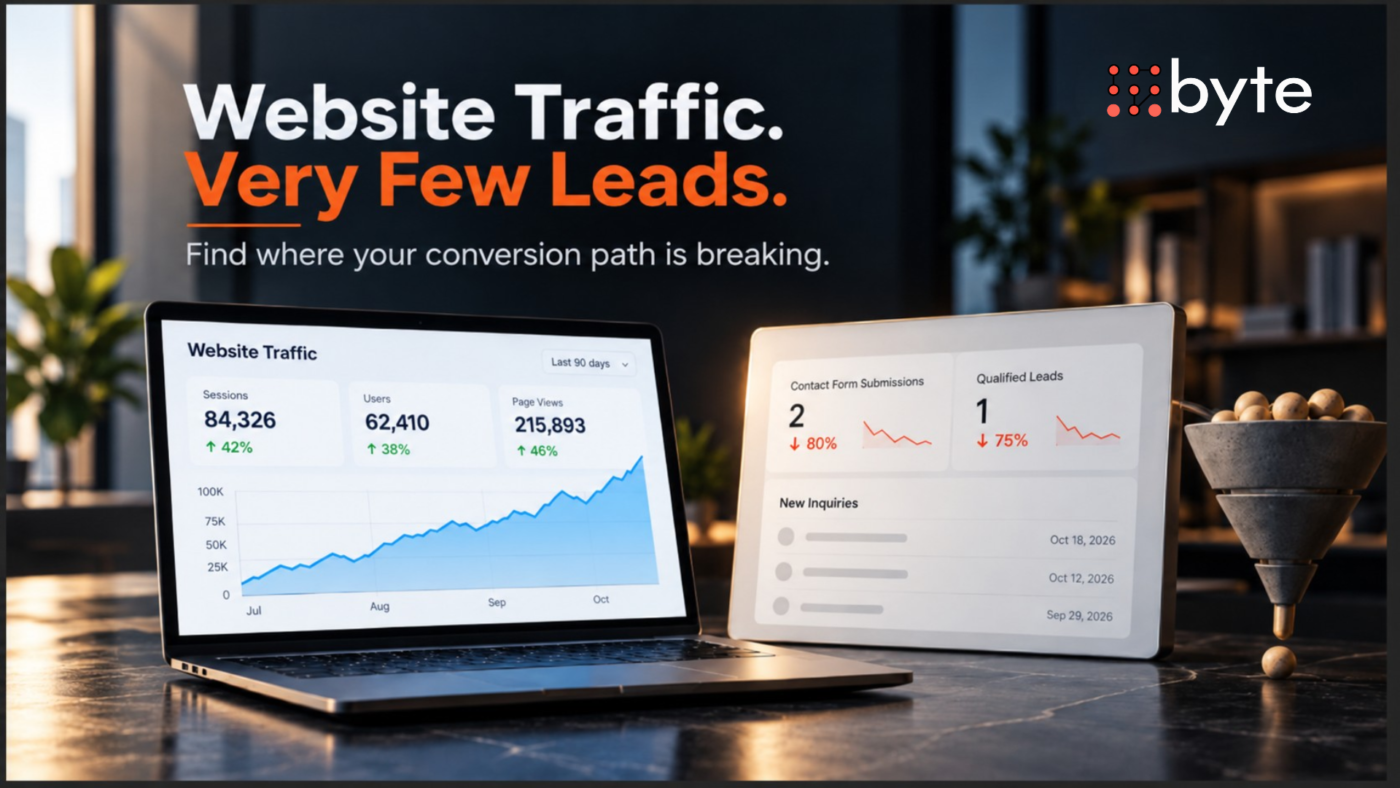
A business can have growing website traffic and still receive very few qualified leads.
That is frustrating because traffic feels like progress. More people are visiting the site. Campaigns may be running. Search visibility may improve. Social posts may be sending visitors to the website.
But traffic alone does not create revenue.
A visitor still has to understand the offer, trust the business, see the next step, and feel confident enough to act. If that path is unclear, a company can keep sending more people to the website without seeing a meaningful increase in the inquiries.
When a business has website traffic but no leads, the answer is not always to spend more on marketing. The better first step is to find where conversion is breaking.
A practical way to diagnose the issue is to review the full lead path:
Traffic Source → Landing Page → Offer → CTA → Form → Follow-Up → Qualified Lead
Traffic creates opportunities. Conversion depends on what happens after the visitor arrives.
Traffic Is Not the Same as Demand
Not every website visit represents a potential customer.
Some visitors are researching generally. Some are comparing options. Some arrive through a keyword that is only loosely connected to the service. Others may not fit the target customer profile at all.
This is why total website traffic can be misleading.
A company may see traffic increase and assume marketing is working, but the more useful question is:
Are the right people reaching the right pages with the right intent?
For example, a consulting firm may receive visitors to a blog post about business planning. That traffic may be useful for awareness, but not every reader is ready to hire an advisor. Some may be students, early researchers, or business owners looking for a template instead of professional support.
That does not mean traffic has no value. Some traffic helps educate potential buyers and support future demand. But each type of traffic should have a clear role in the customer journey.
A smaller number of high-intent visitors can generate more qualified inquiries than a large number of visitors who are not ready, relevant, or aligned with the offer.
For more on how different channels create different types of visibility, see SEO vs. PPC: Which Should Your Business Invest In First?
Start With the Source of the Traffic
Before changing the website, review where visitors are coming from.
Different traffic sources behave differently.
Organic search visitors may arrive through service pages, blog articles, or informational keywords. Paid search visitors may be closer to a buying decision if the campaign targets high-intent terms. Social media visitors may be curious but less ready to convert. Referral traffic may already carry some trust if the visitor came from a partner, directory, or recommendation.
The source matters because it shapes what the visitor expects.
If a paid ad promises a specific service but sends visitors to a general homepage, conversion may suffer. If an SEO blog attracts broad informational traffic but has no clear next step, readers may leave without contacting the business. If social media sends visitors to a page that does not quickly explain the offer, attention may disappear.
A useful review should ask:
- Which sources bring the most visitors?
- Which sources bring the most qualified inquiries?
- Which pages do visitors land on first?
- Which pages produce form submissions, calls, or booked meetings?
- Which channels create traffic but little action?
The goal is not to criticize one channel. The goal is to understand whether the traffic source and landing experience match each other.
A business may not have a traffic problem. It may have a traffic alignment problem.
Check Whether the Landing Page Matches the Visitor’s Need
A visitor usually arrives with expectations.
They clicked on a search result, ad, social post, email, or link because something suggested the page would answer a need. If the page does not quickly confirm that they are in the right place, they may leave.
This is one of the most common conversion issues.
The business may be offering the right service, but the page may not make that clear quickly enough.
A strong landing page should answer four questions quickly:
- What does this company offer?
- Who is this service for?
- What problem does it solve?
- What should the visitor do next?
If the page begins with vague language, broad claims, or a long company introduction, the visitor may not stay long enough to understand the value.
For example, a page that says “We help businesses grow through innovative solutions” may sound professional, but it does not tell the visitor enough. A stronger page explains the specific service, the business problem, and the outcome more directly.
The visitor should not have to work hard to understand why the page matters.
If the landing page does not match the visitor’s needs, more traffic will only send more people into the same weak experience.
Make the Offer Clear Before Asking for Action
Many websites ask visitors to take action before the offer is clear.
They use buttons such as “Contact Us,” “Get Started,” or “Book a Call,” but the visitor may still be unsure what they are getting, what the business actually does, or whether the service fits their situation.
A call to action works better when it follows a clear reason to act.
The offer should explain what the business helps with in practical terms. It should also make the next step feel relevant to the visitor’s problem.
Instead of only saying:
Contact us today
A stronger service page might say:
Speak with Byte Advisory about improving your website, marketing funnel, and lead conversion path.
That is more specific. It tells the visitor what the conversation is about.
The offer does not need to be complicated. In many cases, clarity matters more than creativity.
A visitor should understand what support is available, what type of business it is for, what problem it addresses, and what happens after they inquire.
If the offer is unclear, the visitor may not reject the business. They may simply leave because the next step does not feel obvious enough.
Strengthen the CTA and Lead Capture Path
A website can lose leads because the call to action is weak, hidden, or poorly placed.
Some pages only show a contact button in the header or footer. Others place the CTA after too much text. Some use generic wording that does not connect to the visitor’s needs.
The CTA should appear at logical points on the page, especially after explaining the problem, the service, and the value.
A good CTA is not just a button. It is part of the conversion path.
That path may include a clear button, a short form, a contact page, a booking link, a phone number, a relevant lead magnet, a consultation request, or a simple next-step explanation.
The visitor should know what will happen after they take action.
Will someone call them? Will they receive an email? Are they booking a consultation? Are they submitting a project inquiry? Are they requesting an audit?
Uncertainty creates friction.
A page may attract the right visitor and explain the offer well, but if the next step feels unclear or inconvenient, leads can still be lost.
Look for Trust Gaps
Visitors often need reassurance before they contact a business.
That is especially true for services that involve strategy, finance, software, marketing, or advisory work. The visitor may decide whether the company understands their problem, has relevant experience, and can be trusted with an important business decision.
Trust signals help reduce hesitation.
These may include clear service descriptions, case studies or examples, client outcomes, testimonials, team credentials, industry experience, process explanation, portfolio work, professional design, consistent branding, and helpful educational content.
A website does not need to overwhelm the visitor with proof. But it should provide enough confidence for the visitor to feel that reaching out is reasonable.
Trust gaps are often subtle.
A website may look polished but still feel thin. The service may sound good but lack examples. The page may describe the company but not show how it works. The visitor may like the offer but hesitate because the business has not given enough reason to believe it can deliver.
If people visit the site but do not inquire, trust may be part of the issue.
Reduce Form and Follow-Up Friction
Sometimes the problem is not the page. It is the lead capture process.
A form can quietly reduce conversions if it asks for too much information too early. A visitor who is willing to start a conversation may abandon the page if the form feels long, unclear, or unnecessary.
For many service businesses, the first form should collect enough information to begin a useful conversation without making the visitor feel like they are completing an application.
Useful fields may include:
- Name
- Company
- Service interest
- Short message
More detailed questions can come later.
The form should also be tested regularly. Broken forms, missing notifications, slow confirmation messages, or unclear submission pages can all create lost leads.
Follow-up matters as well.
If a lead submits a form and receives no clear response, the conversion path is still weak. The website generated the inquiry, but the business may lose the opportunity after the submission.
This is where the website, CRM, automation, and sales processes need to work together.
Byte Advisory’s article on Why Paid Ads Fail Without the Right Funnel explores this broader issue: marketing performance depends not only on attracting visitors, but also on what happens after they arrive.
Use Tracking to Find the Real Drop-Off Point

Without tracking, businesses often guess.
They may assume the website needs a redesign, the ads are poor, the SEO is weak, or the offer is wrong. Any of those could be true, but the business needs evidence.
Conversion tracking helps show where the breakdown is happening.
At a basic level, the business should understand:
- Which traffic sources bring visitors
- Which landing pages receive traffic
- Which pages visitors leave from
- Which CTAs are clicked
- Which forms are started
- Which forms are submitted
- Which leads become qualified opportunities
- Which channels produce revenue, not just visits
This matters because different problems require different fixes.
A high bounce rate may point to weak relevance, unclear page messaging, or poor page performance. Strong page engagement with few clicks may suggest that the offer is not clear enough, or the CTA is not visible at the right moment. CTA clicks without form submissions may indicate form friction, while submitted forms that produce few qualified leads may point to traffic quality, targeting, or messaging problems.
When qualified leads still do not close, the issue may sit deeper in the sales process rather than on the website itself.
Better tracking helps the business stop treating conversion as one vague problem and start identifying the specific point of failure.
Fix the Conversion Path Before Buying More Traffic
When leads are low, it is tempting to buy more traffic.
That can help if the current traffic volume is too small to generate enough opportunities. But if the conversion path is weak, more traffic may simply increase the number of people who leave without taking action.
Before increasing marketing spend, review the path from visitor to lead:
Traffic Source → Landing Page → Offer → CTA → Form → Follow-Up → Qualified Lead
Each step should support the next. The traffic source should match the audience. The landing page should confirm the visitor is in the right place. The offer should be easy to understand. The CTA should make the next step clear. The form should be simple enough to complete. Follow-up should keep the opportunity moving.
This is why conversion is not only a website issue. It is a full customer journey issue.
The strongest marketing systems connect visibility, message, website experience, lead capture, tracking, and follow-up.
Traffic Should Lead Somewhere
Website traffic is valuable when it supports a business outcome.
More visitors can increase awareness, improve learning, and create more opportunities. But traffic by itself does not guarantee leads.
If your website is receiving visitors but not generating inquiries, the first step is to diagnose where the conversion path is breaking. Review the source of traffic, the visitor’s intent, the landing page, the clarity of the offer, the strength of the CTA, the trust signals, the form of experience, and the follow-up process.
The answer may not be one large change.
It may be several small improvements that make the next step clearer and easier.
Traffic creates opportunities. A clear conversion path turns that opportunity into action.
Byte Advisory helps businesses connect traffic, website experience, lead capture, tracking, and follow-up, so marketing activity can be measured against real business outcomes.
Getting website traffic but not enough leads? Speak with Byte Advisory about identifying where conversion is breaking and what needs to improve before increasing marketing spend.